The social component is the part of a particle swarm optimization velocity update that attracts each particle toward the swarm’s collective knowledge, usually the best position found by its neighbors or the swarm. It promotes collaboration and convergence by using group experience rather than only a particle’s personal history. section 9.2.1
Treat the social component as the collective-learning parameter c2:
- Increasing c2 makes particles more strongly follow neighbors’ best solutions and generally favors exploitation of promising regions. section 9.5.2
- When c1 > c2, personal experience receives more influence and exploration is favored; when c2 > c1, local exploitation becomes stronger. section 9.5.2
- Setting c1 = 0 creates a social-only model in which particles are attracted to nbest, while c2 = 0 removes social influence. section 9.5.2
- Keep c1 + c2 at or below 4; in adaptive PSO, increase c2 as c1 decreases over successive iterations. section 9.5.2
Friends choosing amusement-park rides
Imagine friends searching an amusement park for the most thrilling rides. A friend who is drawn toward the group’s best-known ride illustrates the social component: collective discoveries guide the next movement, while personal favorites represent the separate cognitive influence. section 9.2.1
Figure 9.13 Cognitive and social acceleration coefficient updates. c1>c2 results in more exploration, while c2>c1 may lead to more exploitation.
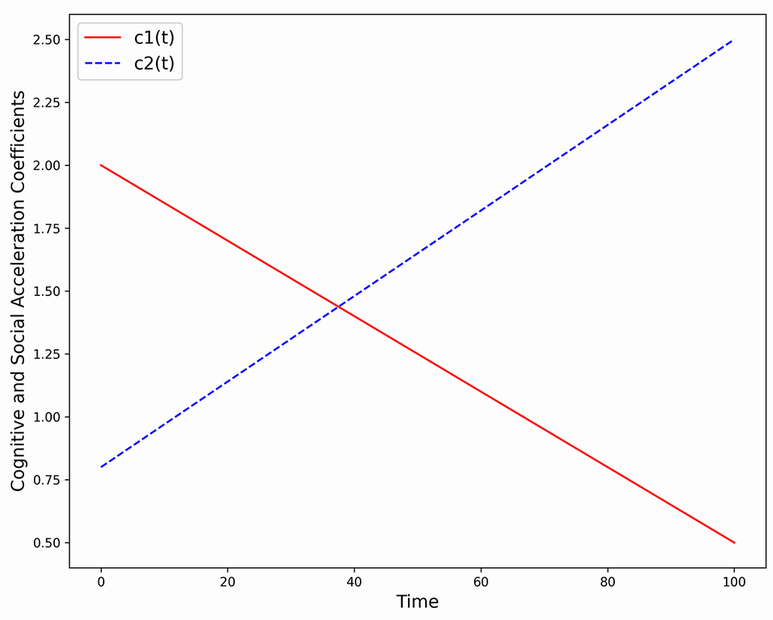
The coefficient-update figure shows how starting with c1 > c2 and later making c2 higher shifts PSO from exploration toward exploitation. section 9.5.2

