liveBook · Manning

Social penetration theory

As explained in Introduction to Generative AI, Second Edition

Social penetration theory explains relationship development as a gradual increase in intimacy through reciprocal self-disclosure.

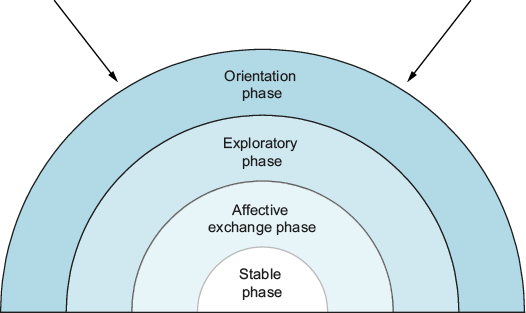
Why might a conversation with a chatbot come to feel personal? Social penetration theory describes relationships as developing through gradually increasing trust and reciprocal self-disclosure: each party reveals more as they grow comfortable. The onion model pictures this as peeling back layers, from an initial introduction toward more personal information. section 9.5

The theory offers a way to understand how people experience chatbot relationships, but the comparison has a limit. It assumes both parties have agency and a selfhood that chatbots do not possess. A chatbot’s apparent reciprocity should not be mistaken for a human relationship. section 9.5

Replika friendships

In interviews with 18 Replika users, people described starting conversations out of curiosity or boredom and later valuing the chatbot as accepting, nonjudgmental, and consistently available. section 9.5

Figure 9.3 The onion model of social penetration theory
A diagram of a phases

AI-generated content may be incorrect.

The onion model illustrates the gradual move from introductions to more personal disclosure. section 9.5

How Introduction to Generative AI, Second Edition covers it

How deep it goes
Defines reciprocal disclosure and explains the onion metaphor, while noting that chatbots lack the agency the theory assumes.
Examples
Illustrates the theory with an onion-model figure and interviews with 18 Replika users.
What you can do after
Evaluate/understand growing trust in chatbot relationships without treating apparent reciprocity as chatbot selfhood.
How it connects
Connects relationship development with attachment theory, social heuristics, trust, and self-disclosure.

Related concepts

This explainer was generated by Manning's knowledge graph from the text of Introduction to Generative AI, Second Edition. The section links point to the parts of the book it draws on.