A sociotechnical system is a network of interacting social, technical, and cognitive components: people, team structures, tasks, physical environments, and software systems. Decisions in one area affect the others, so effective design balances them rather than optimizing technology in isolation. section 3.0 section 3.1.4
The open-plan office
Moving to an open-plan office may improve communication, collaboration, equality, health, or cost in some organizations. Copying the layout, however, can optimize the physical system while neglecting organizational structure, people, and task systems. The example illustrates why a technical or environmental change must be assessed for its social and cognitive consequences. section 3.1.4
Use the concept to make design consequences visible:
- Create and share a larger mental model so teams understand dependencies and the effects of local decisions. section 3.1.4
- Model collaboratively to make design and architecture explicit, reduce ambiguity, and prevent workarounds from adding complexity. section 3.1
- Compare competing heuristics, discuss tradeoffs, and record lessons in a heuristics journal after each session. section 3.7
Figure 3.1 A sociotechnical system is the relationship between the technical system (the tasks and the physical system) and the social system (structure and people). When designing software, we often forget about the effect of the social system.4
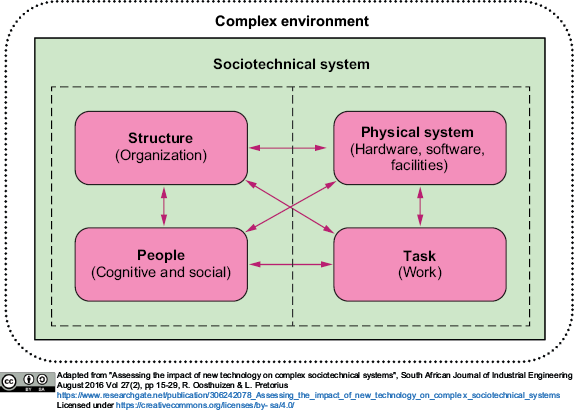
Use the figure to distinguish the technical system—tasks and physical environment—from the social system—structure and people—and inspect their relationship. section 3.1.4
