A software-defined network (SDN) separates network intelligence from message forwarding. A controller centralizes some or all Control Plane functions, while network devices retain distributed Data Plane forwarding. section 22.2 section 22.2.2
SDN organizes control and automation into three layers:
- Application Layer communicates network requirements and desired behaviors to the controller. section 22.2.2
- Control Layer translates high-level requirements into actionable instructions for network devices. section 22.2.2
- Infrastructure Layer contains routers and switches that execute the controller’s instructions. section 22.2.2
- Northbound interfaces connect applications to the controller; southbound interfaces connect the controller to infrastructure devices through APIs and protocols. section 22.4
Cisco SDN solutions
Cisco SD-Access automates wired and wireless campus LANs, SD-WAN provides an SDN approach for WANs, and ACI targets data-center networks. Each builds a virtual overlay over a physical underlay; together they form a fabric. SD-Access uses VXLAN tunnels, while SD-WAN uses IPsec tunnels. section 22.2.3
Figure 22.5 SDN architecture centralizes the Control Plane functions in the controller. However, the Data Plane functions (message forwarding) remain distributed among each network device.
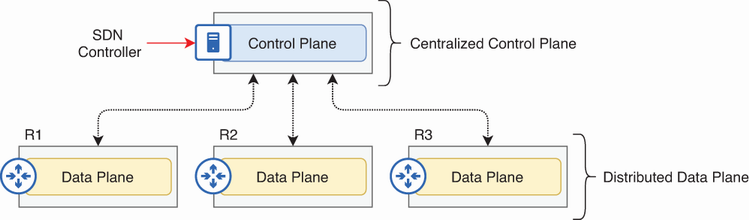
Use the architecture figure to distinguish centralized Control Plane functions from distributed Data Plane forwarding. section 22.2.2
Figure 22.6 The three layers of SDN architecture: Application, Control, and Infrastructure. The NBI facilitates communication between the Application and Control Layers, and the SBI facilitates communications between the Control and Infrastructure Layers.
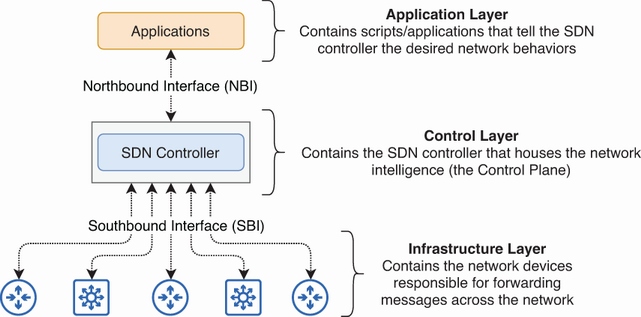
Use the layered architecture figure to trace application requirements through the controller to infrastructure devices. section 22.2.2
