Software delivery moves intent toward usable outcomes through a continuous cycle of execution, validation, and learning—not a one-way sequence. Decisions and feedback at each stage can send work upstream. AI can speed up producing code and tests, but alignment, validation, and ownership still matter. section 1.2 section 1.4
Trace the work loop through its connected stages:
- Intent → Code: turn requirements into implementation, making assumptions visible. section 1.2.1
- Code → Build/Test → Review: validate the change and surface issues through tests and review. section 1.2.1
- Review → Staging → Production: deploy, test against realistic conditions, and respond to runtime behavior. section 1.2.1
- Run → Intent: use production learning to revise understanding and requirements. section 1.2
A feature exposes the loop
A notification-preferences change passes unit tests but lacks integration coverage. Review uncovers an architectural mismatch; staging reveals legacy data problems; production load exposes database locking. Each discovery triggers revision, and production feedback reveals gaps in the original requirements. section 1.2.1
Figure 1.2 Simplified SDLC model showing the progression from intention to production.
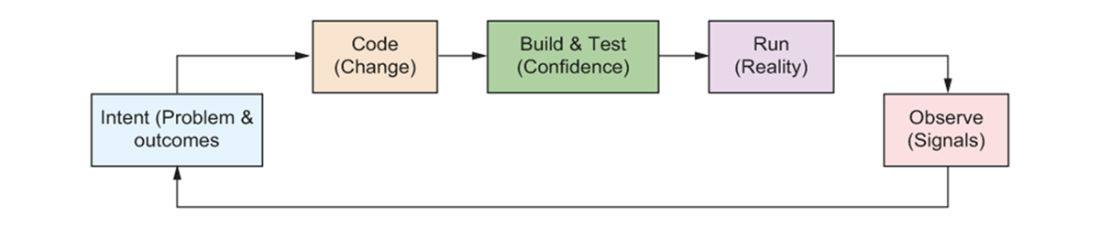
Use the simplified SDLC diagram to follow work from intention toward production. section 1.2.1
When delivery slows, locate the constrained part of the loop before choosing a fix. Delays may reflect unclear requirements, slow or brittle tests, or limited review capacity. Improving code creation alone does not necessarily improve delivery as a system. section 1.2 section 1.4
