Software supply chain security extends cybersecurity governance beyond an organization’s own systems to its vendors, suppliers, contractors, and other partners. A third party can become an entry point to the organization’s systems, so protecting assets requires identifying these relationships, assessing their risks, and checking whether security requirements remain effective. section 5.7 section 1.4
Turn that goal into a repeatable third-party risk process:
- Catalog providers and prioritize them by the sensitivity of data they handle and the importance of the relationship. A healthcare provider, for example, would give particular attention to vendors handling patient data. section 5.7.1
- Set security requirements, including appropriate encryption and access controls. Assess vendors against internal policies; validated HITRUST, SOC2, or ISO 27001 certifications may substitute for a comprehensive questionnaire. section 5.7.1
- Put security expectations, incident-handling procedures, and audit rights in contracts. Monitor compliance and address vulnerabilities rather than treating the initial assessment as the end of the process. section 5.7.1 section 5.7
Deciding whether vendor oversight is ready to expand
A produce retailer reviews its existing vendors before adding another supplier. Its targets are 100% adherence to security standards, at least 90% completion of annual reviews, and 90% vendor compliance when audited. A dashboard shows nearly all vendors meet the standards, but only 75% of annual reviews are complete and 80% of vendors pass audits. The response is to investigate remaining compliance gaps and consider more review capacity, process improvements, or more frequent audits—not to declare the supply chain secure from a single favorable measure. section 5.7.3
Figure 5.13 On the left, Foodie Fruits’ third-party supply chain risk dashboard indicates problems with delayed compliance and inconsistent adherence to security standards. On the right, the dashboard shows improvements in compliance and adherence to security standards.
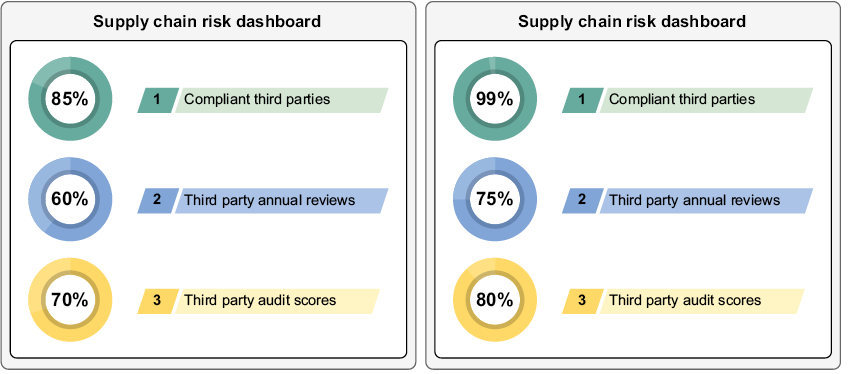
Compare the before-and-after vendor dashboards, then check each improved measure against its target; improvement alone does not establish full compliance. section 5.7.3
Report unresolved third-party risk alongside a specific decision. If vendor assessments reveal increased risk, recommend additional assessments for key suppliers and enhanced monitoring so leadership can direct attention where it is needed. section 4.3.1

