A food truck needs more than a tasty menu: its service window, cooks, grill, and fridge must work together, including during a lunch rush. Software architecture is similarly about a system’s shape and the reasons for that shape. Its significant decisions affect how the system is built, tested, deployed, and changed. section 1.3
Figure 1.2 A software system, like a food truck, has a distinct structure. The API is the service window, the business logic is the cook, and dependencies like the database and cache are the grill and fridge.
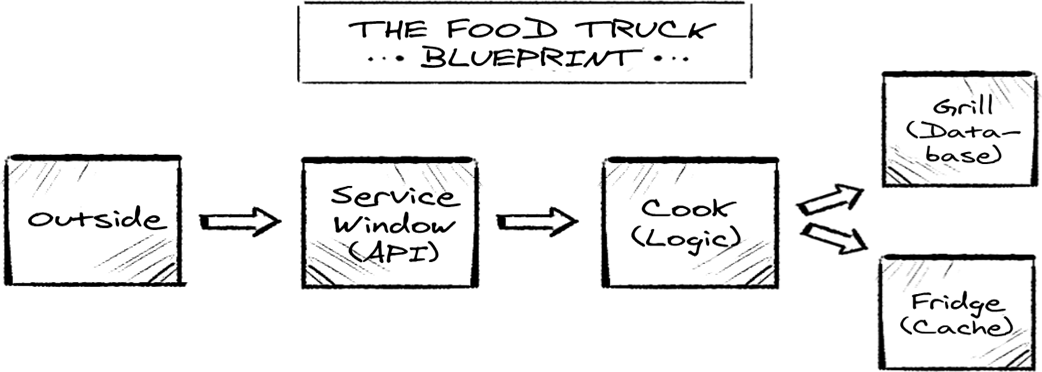
The food-truck layout maps familiar working parts to an API, business logic, and dependencies. section 1.3
Architectural decisions happen at many scales. Choosing a database, placing logic in a class, or changing a configuration line can make later work easier or harder. A useful test is whether the choice significantly affects the ability to build, ship, or change the system. Not every decision needs formal review: a disposable script may be fine with duct tape. section 1.1 section 1.3
Architecture also translates business needs and user requirements into technical choices. Before solving “make it faster,” ask why, for whom, and what is actually needed. The goal is a complete solution for today, not elaborate protection against every imagined future. section 1.4
A repeatable thinking process turns a vague idea into a defensible decision:
- Spark: identify the idea or request. section 1.10
- Inquiry: ask questions to uncover the real need. section 1.10 section 1.4
- Sketch: give the proposed approach a shape. section 1.10
- Options: compare alternatives, including a pro and a con for each. section 1.10 section 1.9
- Decision: record the choice, its rationale, and its consequences. section 1.10
Pick your pain on purpose
A bank transfer may favor consistency because a wrong balance is costly. A social feed may favor availability because a slightly stale post can be preferable to an error. Friendster’s emphasis on consistency came with availability costs, including long page loads: an excellent technical goal can still be the wrong business tradeoff. section 2.9.1
There is no universally perfect architecture. Consider behavior under stress and the cost of change, not just today’s structure. Apply sound principles consistently across scales: keep methods focused, classes cohesive, and components loosely coupled. section 1.10 section 3.7

