SOLID is a set of five object-oriented design principles for making software more flexible and maintainable. Use them as a review lens when a design meets today’s requirements but may be difficult to extend for future cases. section 3.3 section 3.4
The principles focus on how responsibilities, extensions, and dependencies are arranged:
- Single responsibility principle (SRP): give a class one job and one reason to change. section 3.3
- Open/Closed principle (OCP): extend classes, modules, or functions without modifying their existing behavior. section 3.3
- Liskov substitution principle (LSP): replace a superclass object with a subclass object without breaking program correctness. section 3.3
- Interface segregation principle (ISP): keep interfaces small so clients do not depend on methods they do not use. section 3.3
- Dependency inversion principle (DIP): have high-level modules depend on interfaces rather than low-level implementations. section 3.3
Extending an asset model
Create an Asset parent class for shared properties, then let Hardware inherit from it. New asset types such as Software can follow the same parent contract. Model depreciation as a DepreciationStrategy interface with separate concrete strategies, allowing the calculation method to be swapped without changing the Asset model. Review generated diagrams and design suggestions before adopting them; prompts and output are aids for iteration, not proof that a design is ready. section 3.3 section 3.3
SOLID complements architectural documentation rather than replacing it. Class diagrams can expose inheritance, interfaces, and dependencies; C4 views can then place those choices within the wider system structure. AI-assisted design exploration can quickly produce candidate diagrams and alternatives, but the resulting model still needs deliberate evaluation as requirements evolve. section 3.3 section 3.4
Figure 3.5 We have added a depreciation strategy to our object model. This introduction allows us to swap out the method by which we can calculate the depreciation of an asset.
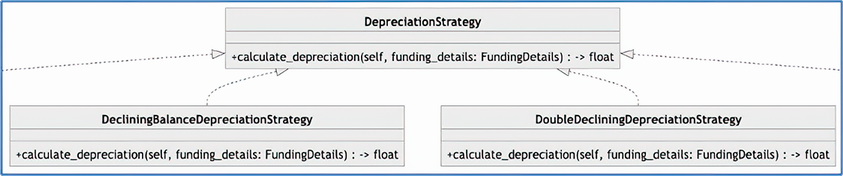
Inspect the strategy-based depreciation model to see an interface separated from its interchangeable concrete implementations. section 3.3


