liveBook · Manning

Source network address translation

As explained in Acing the CCNA Exam: Volume 2 Advanced Networking and Security

Source NAT is a NAT operation that rewrites the source address of a packet.

Source NAT rewrites only a packet’s source IP address. For traffic from PC1 through R1 to 8.8.8.8, the destination remains unchanged, so outside local and outside global addresses are identical. section 9.2.2

Interpret translated addresses from R1’s perspective:

  • Inside local: the inside host’s address as seen from the inside network. section 9.2.2
  • Inside global: the inside host’s address as seen from the outside network. section 9.2.2
  • Outside local and outside global: the outside host’s address, unchanged because destination NAT is not performed. section 9.2.2
Figure 9.3 The inside/outside distinction from the perspective of R1. The inside network is R1’s internal network, and the outside network is the external network (everything else).
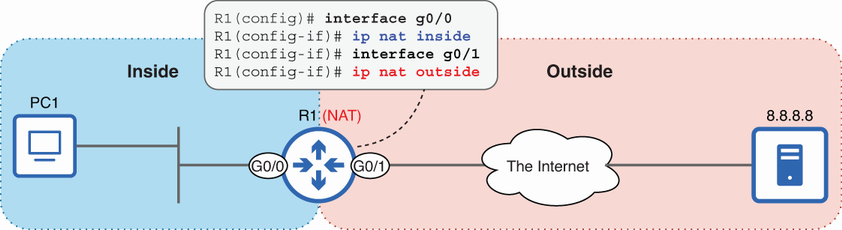
Use the diagram to distinguish R1’s inside network from the outside network. section 9.2.2

How Acing the CCNA Exam: Volume 2 Advanced Networking and Security covers it

How deep it goes
Defines address terminology and perspective, but stops short of configuration, verification, and troubleshooting procedures.
Examples
Uses PC1, R1, and 8.8.8.8 to illustrate source-only translation and address perspectives.
What it assumes
Distinguishes inside from outside and local from global while defining each address category explicitly.
What you can do after
Evaluate translated packets by identifying inside-local, inside-global, outside-local, and outside-global addresses.
How it connects
Connects source NAT with destination NAT, inside and outside networks, and local and global addresses.

Related concepts

This explainer was generated by Manning's knowledge graph from the text of Acing the CCNA Exam: Volume 2 Advanced Networking and Security. The section links point to the parts of the book it draws on.