A spanning-tree instance is an independently running spanning-tree process associated with one VLAN or a group of VLANs. Each instance can select its own root bridge and block different links, allowing VLAN traffic to use different paths. section 14.3.1
Use the instance model to understand these practical effects:
- PVST+ and Rapid PVST+ run one instance per VLAN, creating a separate spanning tree and unique BPDUs for each VLAN. section 14.3.1 section 15.1
- Separate instances can balance traffic because different VLANs can disable different redundant links. section 14.3.1
- Many instances consume switch CPU and memory and increase configuration, monitoring, and troubleshooting complexity. section 15.1
- MSTP groups multiple VLANs into one instance, preserving multiple spanning trees while reducing the number of running processes. section 15.1
Two VLANs, two trees
In a LAN carrying VLANs 1 and 2, separate instances can block one redundant link for VLAN 1 and a different link for VLAN 2. Traffic therefore uses both available paths instead of leaving one link unused for every VLAN. section 14.3.1
Figure 15.1 MSTP groups multiple VLANs into each instance. VLANs 1 to 50 are grouped together in MSTP instance 1, and VLANs 51 to 100 are grouped together in MSTP instance 2. This allows the switches to balance traffic over the links in the LAN without requiring a separate STP instance for each VLAN.
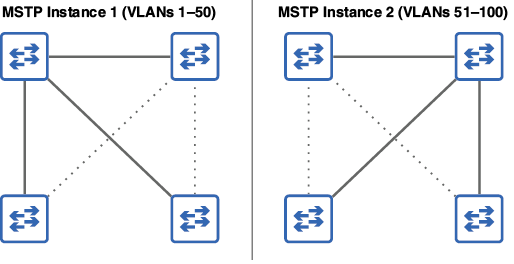
The diagram shows MSTP grouping VLANs 1–50 into one instance and VLANs 51–100 into another, balancing links without running 100 separate instances. section 15.1
