The spanning-tree link-type point-to-point command manually configures an interface's RSTP link type. Use it for a full-duplex switch-to-switch link, which can use RSTP synchronization to reach forwarding quickly. section 15.3
Remember these operational distinctions:
- Full-duplex ports automatically use the point-to-point type, although interface configuration can set it manually. section 15.3
- Half-duplex ports use the shared type and cannot use RSTP synchronization; configure shared links with spanning-tree link-type shared. section 15.3
- End-host ports use the edge type through spanning-tree portfast, not through the link-type command. section 15.3
Interface configuration
Apply spanning-tree link-type point-to-point in interface configuration mode when a port should be treated as an RSTP point-to-point link. Verify the resulting Type field with show spanning-tree; P2p identifies a point-to-point link. section 15.3
Figure 15.7 RSTP differentiates between three link types: point-to-point, shared, and edge. A full-duplex link is considered a point-to-point link. A half-duplex link is considered a shared link. A link between a switch and an end host that uses PortFast is considered an edge link.
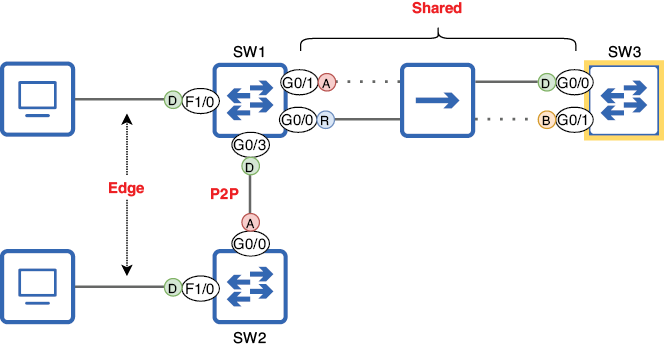
Compare point-to-point, shared, and edge link types by duplex mode, connection type, and RSTP behavior. section 15.3
