A sparse autoencoder learns encoded representations in which few hidden units activate. It uses a flexible hidden-layer size and adds an activation penalty to the reconstruction loss, discouraging overfitting. section 9.7
Its core workflow connects standard autoencoder components with sparsity control:
- Encode input data into a latent representation, then decode it to reconstruct the original data. section 9.11
- Add a sparsity function to the loss; penalize the number of activated neurons, increasing the penalty as more units activate. section 9.7
- Use the penalty to reduce active neurons while retaining a flexible hidden-layer structure rather than relying only on a narrow bottleneck. section 9.7
Sparse autoencoders differ from undercomplete autoencoders in how they address overfitting: the former penalize active units, while the latter constrain the bottleneck size. They remain part of the broader autoencoder family used for encoding, dimensionality reduction, and data compression. section 9.11 section 9.7
Figure 9.3 PCA is linear in nature while autoencoders are nonlinear. This is the core difference between the two algorithms.
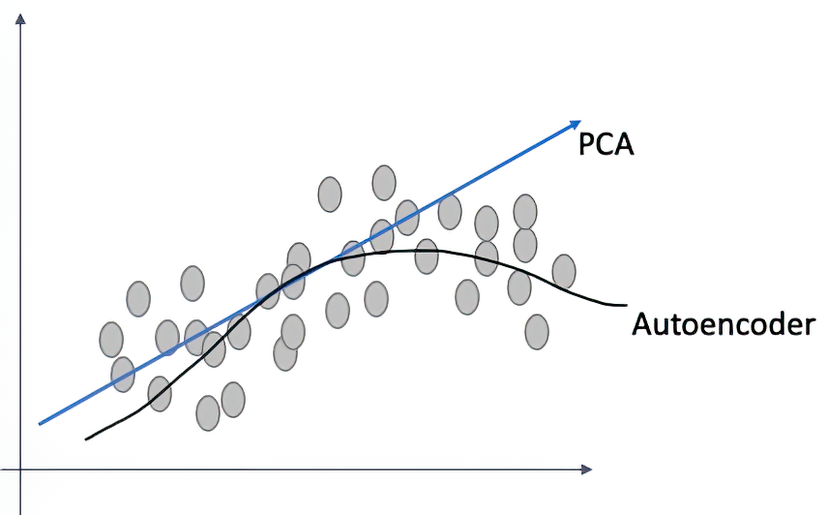
Use the PCA comparison to distinguish linear dimensionality reduction from the nonlinear behavior associated with autoencoders. section 9.7
