liveBook · Manning

SPEA2

As explained in Evolutionary Deep Learning: Genetic algorithms and neural networks

SPEA2 is a multi-objective evolutionary algorithm that uses Pareto dominance and fitness assignment to maintain a diverse approximation of the Pareto front.

SPEA2 is a selection operator for multi-objective evolutionary problems. It maintains a Pareto-front distribution with balanced diversity, helping long-running evolution avoid sticking at specialized or incorrect solutions. section 3.4

Use SPEA2 when:

  • The evolutionary run must preserve diversity over many generations. section 3.4
  • You want a population distributed across the fitness range instead of concentrated around one region. section 3.4
  • You can afford additional generations, because greater diversity may take longer to reach optimum fitness. section 3.4

A practical experiment

Run the selection comparison with a population of 1000 for 15 generations, then inspect the final histogram. Change population size, destinations, and generation count to observe how diversity changes. section 3.4
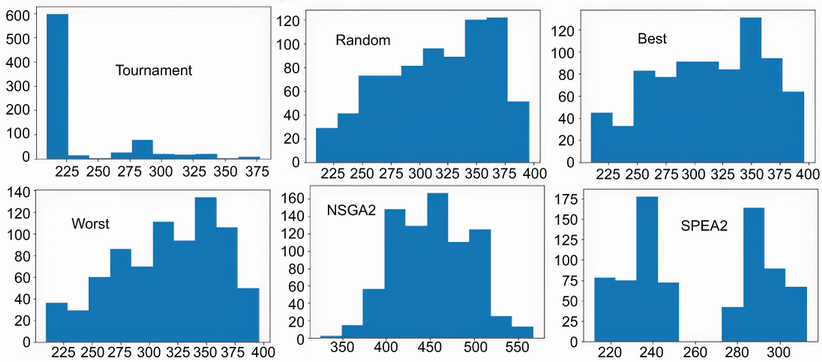
Figure 3.7 A comparison of selection operators on population diversity

Compare the resulting selection-operator histograms to see how SPEA2 distributes population fitness. section 3.4

How Evolutionary Deep Learning: Genetic algorithms and neural networks covers it

How deep it goes
Describes distributional goals and parameter experiments, but does not detail fitness-assignment internals or implementation steps.
Examples
Compares selection histograms using 1000 individuals and 15 generations, then varies destinations, generations, and population sizes.
What you can do after
Apply it via DEAP-oriented evolutionary experiments and evaluate diversity through final population histograms.
How it connects
Relates to genetic algorithms, NSGA-II, tournament selection, crossover, Pareto fronts, and population diversity.

This explainer was generated by Manning's knowledge graph from the text of Evolutionary Deep Learning: Genetic algorithms and neural networks. The section links point to the parts of the book it draws on.