Specialization assigns focused responsibilities to separate agents instead of loading one agent with every tool, domain, and instruction. A triage agent, billing agent, and technical-support agent can outperform one general customer-support agent. section 1.4
Use specialization when a single agent becomes overloaded by tools, prompts, or overlapping tool descriptions. Separating responsibilities narrows each agent’s context and can reduce cost and latency. section 4.2.1
A practical specialization workflow:
- Identify the roles the overloaded agent performs. section 4.2.2
- Create one focused agent for each role and define its limitations, ownership, instructions, and required tools. section 4.2.2
- Connect the agents into a flow so outputs pass between controlled steps. section 4.2.2
Research-plan flow
A monolithic research assistant becomes a research agent that finds sources, a thinking agent that plans the research, and a filesystem agent that writes the plan to a text file. section 4.2.1 section 4.2.2
Figure 4.5 A single agent is transformed into a multi-agent flow. The agent role is broken down into three well-defined, distinct roles/agents, each encapsulating a well-defined set of tools appropriate to that role. The single agent becomes a flow of a research tools agent, a planning agent, and a filesystem agent.
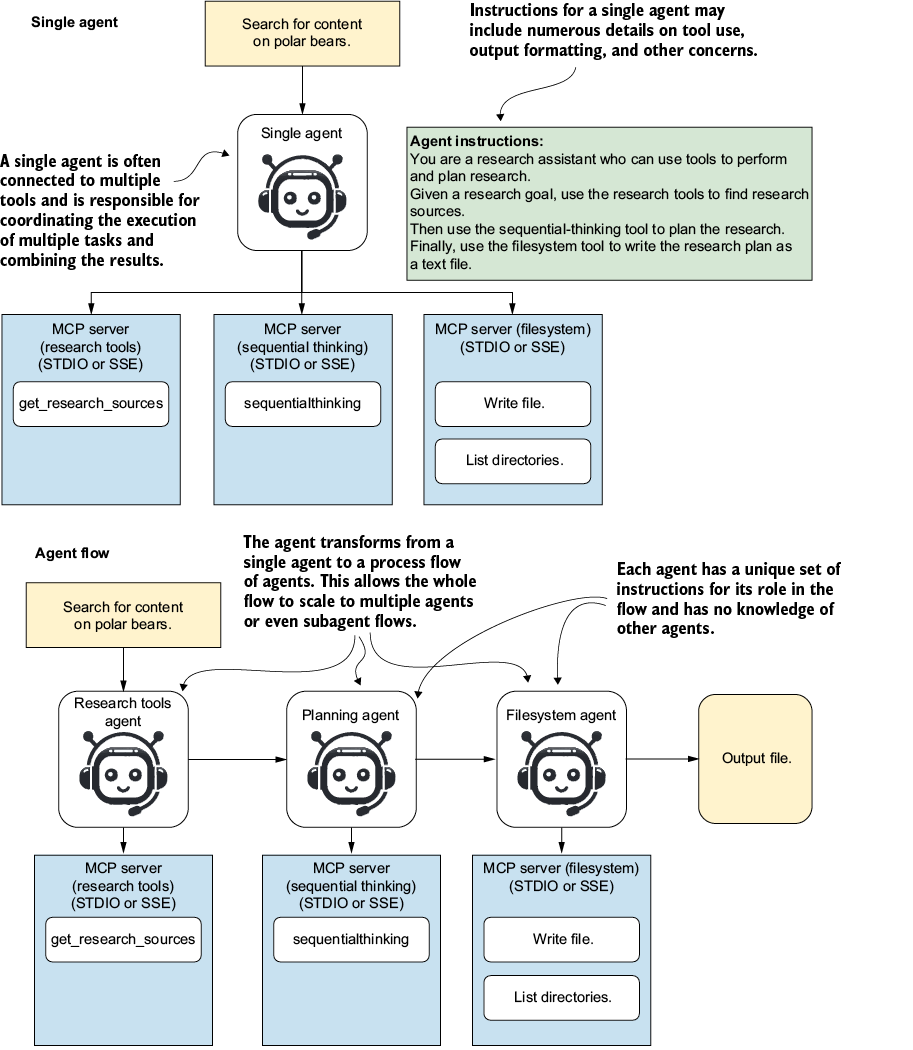
Use the decomposition diagram to compare the single agent with a flow of research-tools, planning, and filesystem agents, each owning appropriate tools. section 4.2.1

