A specific outlier, or specific anomaly, is a data item matching a predefined object, event, error, or condition of interest. It may be statistically unusual, but it may also be common relative to the dataset and abnormal only against an expected or ideal state. Examples include data-entry errors, fraud, network intrusions, and particular chemical reactions. section 4.2
Detection begins by deciding whether the target is specific or merely statistically unusual, and whether it is known or unknown. Rules and classifiers can be more suitable than outlier detectors when the target is too common, too subtle, or obscured by more extreme records. Detectors may still help when targets are rare and sufficiently different. section 4.2.2 section 4.3
Practical handling emphasizes explicit categories and iterative evaluation:
- Define recurring or important outlier types with labels that can be applied consistently; a record may receive multiple labels. section 15.1.1
- Tune detectors, compare hyperparameters, combine multiple detectors with rules, or replace detection with rules or classifiers when appropriate. section 4.2.2
- Review statistically unusual records to discover useful categories or suppress recurring false positives that are not relevant. section 4.2.3 section 15.1.1
Classifying known specific outlier types
When many examples of several specific outlier types form compact regions, a classifier can sort detector results into those categories. Separate one-class models, such as one One-Class Support Vector Machine per useful category, can identify records similar to each category; records matching none remain unclassified. Novel outliers may nevertheless be misclassified as inliers or known categories. section 15.3.2
Figure 15.8 Left pane: dataset with known outliers. Inliers are drawn as dots and outliers as stars. Conceivably, we can create a classifier to separate these, but as the outliers are distributed throughout the space, it is not clear where to draw the decision boundary. This is much more of a problem in higher dimensions. Right pane: where there are many examples each of a small number of specific outliers, it is more feasible to classify these.
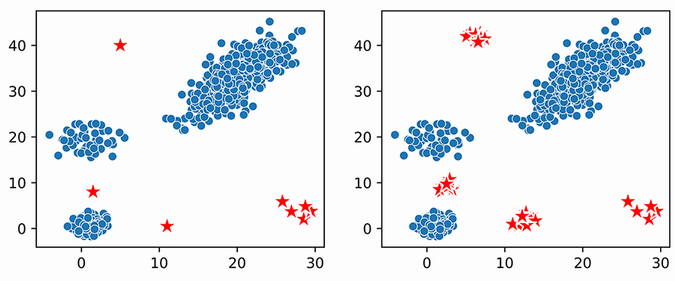
Compare the distributed known-outlier case, where classification boundaries are unclear, with compact specific-outlier clusters that are easier to classify. section 15.3.2
