A speed mismatch occurs when connected network interfaces attempt to communicate at different transmission speeds. Both interfaces enter a down/down state, so the devices cannot communicate. section 8.3.1 section 8.4
Recognize the main operational points:
- Usually trace the problem to misconfiguration, such as one interface set to 100 Mbps and the other to 1,000 Mbps. section 8.3.1
- Distinguish a speed mismatch from a duplex mismatch: speed mismatches produce down/down interfaces, while duplex mismatches leave interfaces operational but greatly reduce performance. section 8.4
- Treat manual speed configuration as a human-error risk and check both connected interfaces. section 8.3.1
Diagnosing R1 and SW1
If R1 G0/1 is configured for 100 Mbps and SW1 F0/1 for 1,000 Mbps, both interfaces appear down/down in show ip interface brief. The output confirms that neither interface is operational and that the devices cannot communicate. section 8.3.1
Figure 8.6 A speed mismatch between a router and a switch. Because of the speed mismatch, their interfaces are in a down/down state; R1 and SW1 cannot communicate.
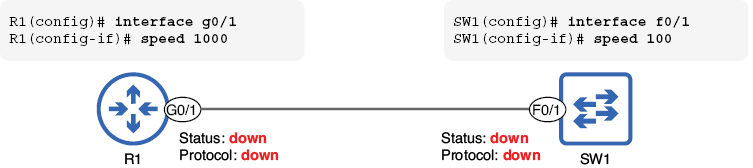
View the router-and-switch scenario showing how a speed mismatch produces down/down interfaces and prevents communication. section 8.3.1
