Speedup compares execution with a baseline against execution after improvement or parallelization. It shows how much faster a computation becomes, not merely how many processors it uses. section 1.6.1
Use speedup to reason about the limits and opportunities of parallel execution:
- Amdahl’s law limits speedup for a fixed-size problem: sequential work remains a bottleneck as processors increase. section 1.6.1
- A mostly parallel task can still reach a hard limit; a construction task with 95% parallel work achieves only about 19× speedup with 512 builders. section 1.6.1
- Gustafson’s law considers growing problem sizes: keeping additional resources busy can make speedup increase with available parallel resources. section 1.6.2
A game with more processors
Adding processors to a graphics-rich game can raise frame rate until the fixed workload reaches its speedup limit. Designers can then use extra processing capacity for greater detail or resolution instead. section 1.6.2
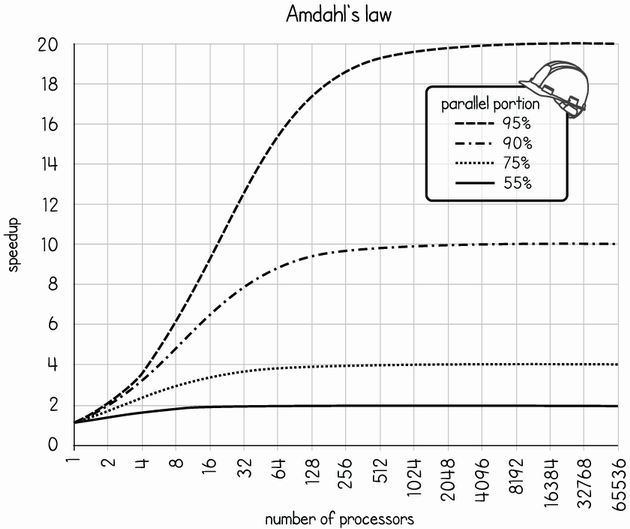
Compare theoretical speedup with processor count and observe how sequential work produces a scalability ceiling. section 1.6.1
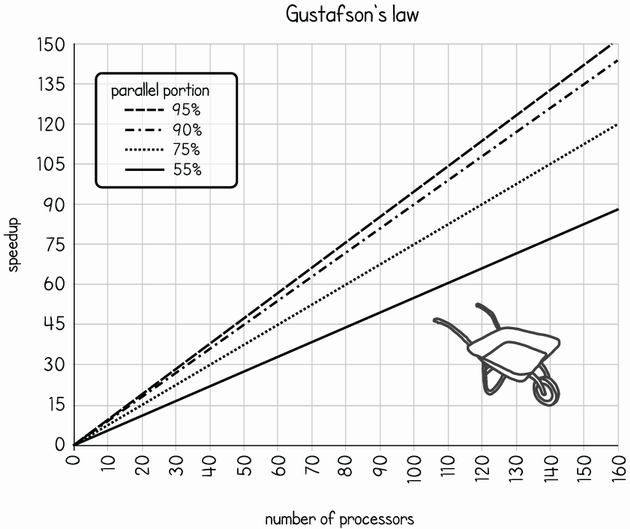
Compare speedup as problem size grows and additional parallel resources remain useful. section 1.6.2

