A spinlock is a mutual-exclusion lock for a shared resource when an execution must keep trying rather than block while another execution owns the lock. In a flight-booking workflow, reserving an entire route must treat the seat updates for all flights as one unit; atomically changing each flight’s seat count separately cannot prevent an incomplete or inconsistent booking. section 12.2 section 12.2.2
A simple spinlock stores its state in an atomic flag: 0 means free and 1 means locked. Lock acquisition repeatedly performs CompareAndSwap from 0 to 1. Only the execution whose swap succeeds owns the lock; failed attempts loop until another execution unlocks it. Unlocking atomically stores 0, making the lock available again. section 12.2.2 section 12.5
A Go implementation follows a short sequence:
- Represent lock state with an int32 whose zero value is unlocked and whose value 1 is locked. section 12.2.2
- Loop on atomic.CompareAndSwapInt32 until changing 0 to 1 succeeds. section 12.2.2
- Yield with runtime.Gosched after a failed attempt so another goroutine can run and potentially release the lock. section 12.2.2
- Release ownership with atomic.StoreInt32, changing the state back to 0. section 12.2.2
Protecting a route reservation
Give each Flight a sync.Locker and initialize it with a new spinlock. The booking operation can sort the flights, lock each one, check whether every flight has enough seats, and then update the group safely. Sorting establishes a consistent lock order for the multi-flight operation, while the spinlock supplies the Locker implementation used by each flight. section 12.2 section 12.2.2
Spinning is not free. Under high contention, waiting executions consume CPU cycles while repeatedly retrying the atomic operation. A futex-based mutex instead suspends and queues waiters until the lock becomes available, avoiding endless looping; Go mutexes likewise queue and suspend waiting goroutines through a semaphore-based implementation. section 12.0 section 12.5
A spinlock can also be extended with TryLock: make one CompareAndSwap attempt and return immediately whether it acquired the lock. The same atomic spinning approach can implement a semaphore whose Acquire waits for a permit and whose Release restores one. section 12.4
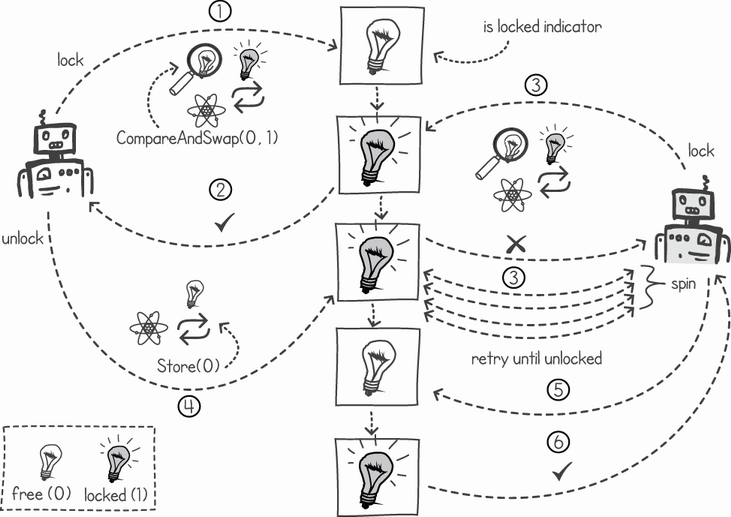
Use the state-transition figure to trace how a failed compare-and-swap keeps retrying until an unlock changes the flag back to free. section 12.2.2

