Use Python’s splat operator (*) to collect an unknown number of function arguments or unpack an iterable into separate arguments. A parameter such as *numbers receives a tuple, including an empty tuple when no arguments are passed. section 2.7
Apply the operator in these closely related ways:
- Define flexible functions with *args or another name; iterate over the resulting tuple rather than indexing it when named parameters would be clearer. section 2.7 section 4.7
- Unpack a list, set, or tuple at the call site: mysum(*[1, 2, 3]) passes three arguments, unlike mysum([1, 2, 3]), which passes one list argument. section 2.7
- Unpack iterable elements into a set with {*numbers}; choose this idiom deliberately because set(numbers) may be clearer to newcomers. section 5.17
A variadic summing function
def mysum(*numbers): output = 0 for number in numbers: output += number return output mysum(1, 2, 3) # 6 mysum(*[1, 2, 3]) # 6 For a function that combines values with +, a first-element implementation can return an empty tuple for no arguments, use items[0] as the initial value, and iterate over items[1:]. section 2.7 section 4.7
Figure 4.6 After assigning the first element to output (from the Python Tutor)
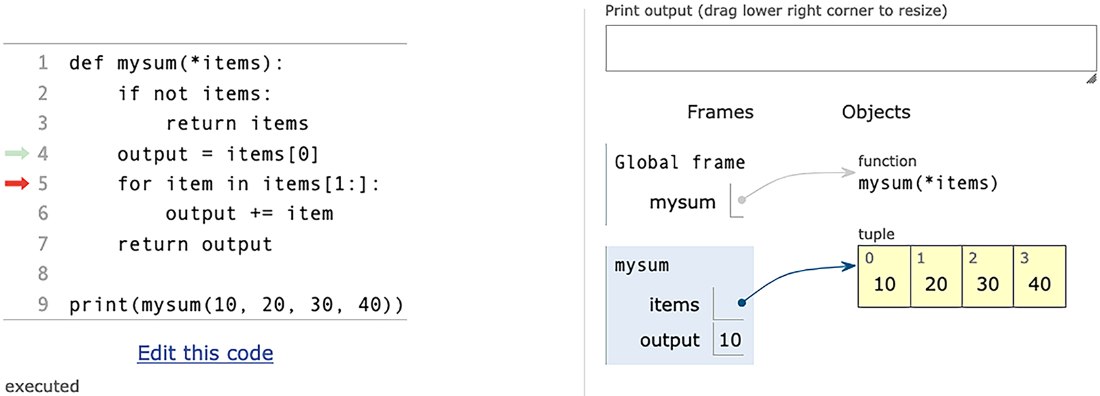
Trace the first-element accumulator version of mysum as the tuple is assigned and used. section 4.7

