Split and merge is a collaborative modeling format for dividing a large group into smaller teams, letting them work separately, and combining their results. It keeps modeling moving while preserving a later opportunity for shared understanding. section 4.5.2
Use the format as a deliberate facilitation sequence:
- Split groups larger than seven into teams of roughly three to seven people. section 4.5.2
- Choose whether teams will model different categories or the same problem independently. section 4.5.2
- Set a fixed working period, then have teams show and tell their results. section 4.5.2
- Walk through the models together and decide how to merge them or continue. section 4.5.2
Two ways to split
In a Big Picture EventStorming session with about 30 people, a pivotal event such as Planning Finalized divided the timeline; successive splits produced workable team sizes. In a 12-person Example Mapping session, two or three diverse teams modeled the same user story independently before merging their results. section 4.5.2
Figure 4.17 Zoomed in part of a Big Picture EventStorming showing how a pivotal event can help split the large group into smaller groups
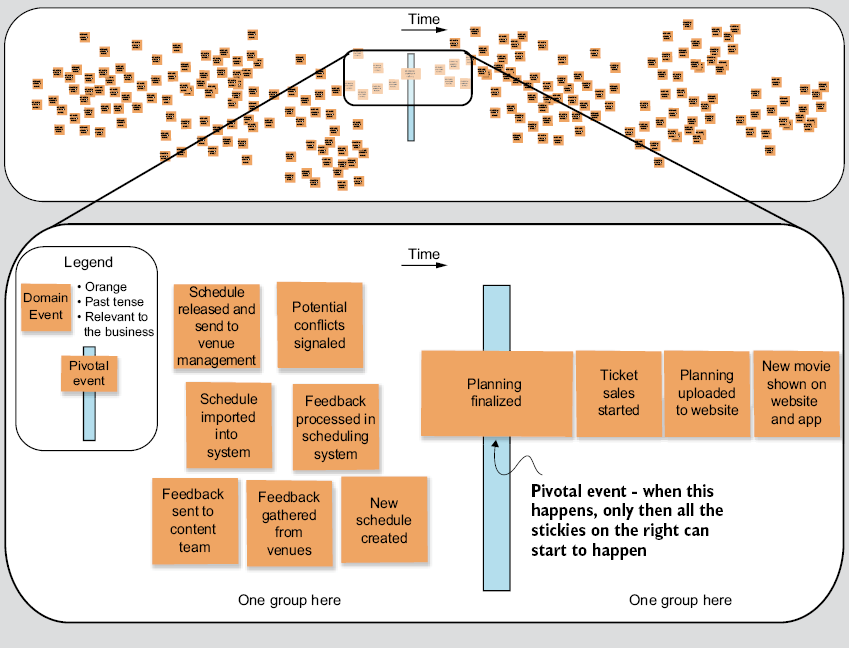
A pivotal event can divide a Big Picture EventStorming timeline and provide a visible boundary for successive group splits. section 4.5.2
