A persistence layer stores, reads, changes, and deletes an application’s data. Spring Data simplifies this work by providing common repository abstractions over different persistence technologies. Instead of implementing every repository class yourself, you declare interfaces and let Spring provide implementations at runtime. section 14.0 section 14.1
Figure 14.1 The Java ecosystem offers many various persistence technologies like Hibernate, JDBC, MongoDB, or others. Each technology has its own abstractions and class design. Spring Data offers a common abstraction layer over all these persistence technologies to simplify the use of multiple persistence technologies.
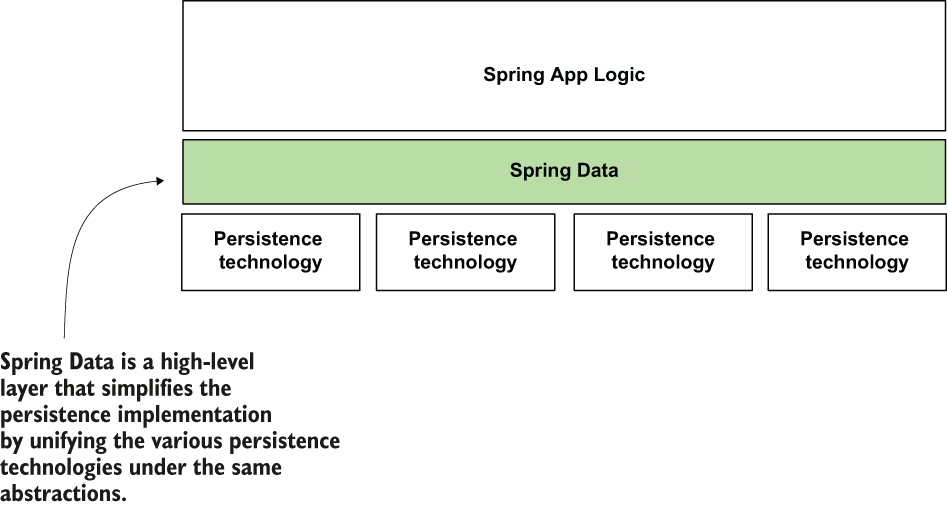
Spring Data sits between the application and persistence technologies, offering a common abstraction over their different APIs. section 14.1
Choose a Spring Data module for the technology your application uses: for example, Spring Data JDBC for JDBC or Spring Data MongoDB for MongoDB. The common approach reduces the amount of repository code you need to write, even though the underlying technologies differ. section 14.5 section 14.1
Repository interfaces can extend Spring Data contracts to inherit operations:
- Repository defines no persistence operations itself. section 14.5
- CrudRepository provides basic create, read, update, and delete operations. section 14.5
- PagingAndSortingRepository adds pagination and sorting support. section 14.5
A repository can also declare custom operations. Use @Query to specify a query explicitly, or let Spring Data derive one from a method name that follows its naming rules. An invalid derived name causes startup to fail. For complex operations, @Query can be easier to maintain than a long derived name. Operations that change data, such as INSERT, UPDATE, or DELETE, must be annotated with @Modifying. section 14.5
Validating data in an automated test app
An automated testing application can use Spring Data to connect to databases and validate data as part of its test scenarios. It can combine this with other Spring capabilities, such as managing application objects or calling external APIs. section 1.3.2

