The Spring IoC container, often called the Spring context, manages application object instances and connects application components with Spring. You make objects known to Spring through configuration, allowing the framework to use them as configured. section 1.2
Spring can control managed objects, including intercepting their methods to add behavior such as error logging. This shifts some control over object creation and method calls from application code to the framework. section 1.2
Where object management helps
An automation test app can use the container to manage instances and keep code maintainable. A desktop app can use it for the same purpose; either kind of app may also use Spring tools to communicate with other systems. section 1.3.2 section 1.3.3
Figure 1.4 Inversion of control. Instead of executing its own code, which makes use of several other dependencies, in an IoC scenario, the app execution is controlled by the dependency. The Spring framework controls an app during its execution. Therefore, Spring implements an IoC scenario of execution.
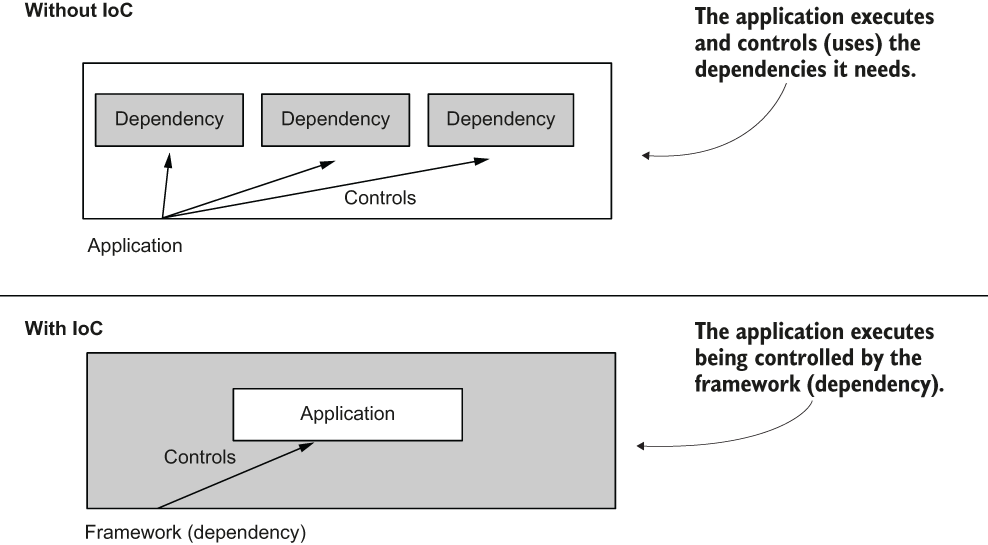
The diagram contrasts application-controlled execution with execution controlled by a dependency such as Spring. section 1.2
