Squeezing is the output phase of a sponge construction. After input is absorbed, the state is permuted and output blocks are read from its rate portion; the capacity remains untouched. section 2.5.2
A longer digest follows a simple repeating pattern:
- Permute the current state. section 2.5.2
- Read as much output as needed from the rate. section 2.5.2
- Repeat the permutation-and-read cycle for more output. section 2.5.2
Producing a longer digest
Once absorbing finishes, read one rate-sized block, permute the state again, and read the next block. Continue until the requested digest length is reached. section 2.5.2
Figure 2.16 To obtain a digest with the sponge construction, one iteratively permutes the state and retrieves as much rate (the upper part of the state) as needed.
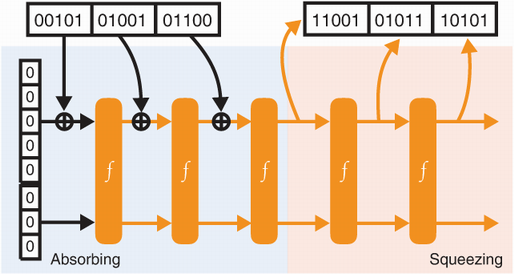
Shows squeezing as repeated state permutations followed by retrieving successive portions of the rate. section 2.5.2
