Stakeholder analysis identifies stakeholders, their roles, their expertise, and the involvement each decision requires. It distinguishes domain experts, users, customers, and development-team members without assuming that one person occupies only one role. section 2.2.2
Figure 2.3 This Venn diagram illustrates the interrelationships between four primary categories of stakeholders in a project or business context: Domain Experts, Users, Development Team, and Customers. Each category is depicted by overlapping shapes, indicating that stakeholders can simultaneously fulfill multiple roles. For example, a stakeholder may possess the specialized knowledge of a Domain Expert while also being a Customer of the product or service. This visual aid helps to identify the complex positions stakeholders may hold and the potential for shared interests and expertise among them.
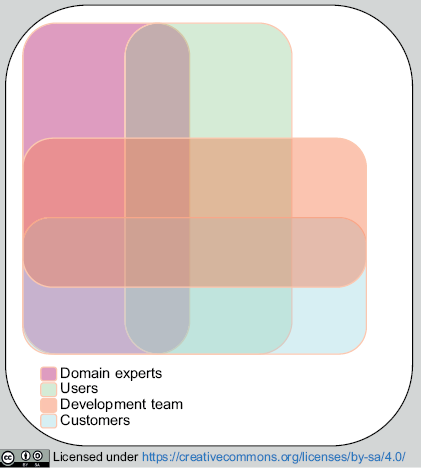
Use the overlapping categories as a visual prompt: map people across domain expertise, users, customers, and the development team, then identify shared roles and missing expertise. section 2.2.2
Turn the analysis into engagement decisions by asking:
- Should each stakeholder be informed, participate without deciding, or take part in decision-making? section 2.2.2
- Where are the gaps in domain expertise, and which people can help close them? section 2.2.2
- Which collaborative modeling session fits the group, and what expectations should be set before inviting them? section 2.2.2
BigScreen stakeholder map
A marketing user researcher may also be a domain expert; an operations business analyst may be both a back-office user and domain expert; experienced developers, testers, product owners, executives, and customers contribute different kinds of knowledge and authority. Mapping these overlaps clarifies whom to invite and why. section 2.2.2
