A standalone cluster uses one Anthos on bare metal cluster as both the admin and user cluster. It suits independently managed edge locations and isolated networks, but places control-plane responsibilities and workloads together. section 5.4 section 17.2.1
Plan the deployment around these operational consequences:
- Save three nodes in a high-availability setup because a separate admin cluster is unnecessary. section 17.2.1
- Protect node SSH keys and Google Cloud service account keys because workloads share the cluster with the control plane. section 5.4 section 17.2.1
- Apply RBAC, OPA, network policies, and auditing to strengthen cluster security. section 17.2.1
- Provision at least five nodes for the stated high-availability setup, while Anthos 1.8 introduced a one-node minimum and an edge profile for reduced hardware requirements. section 5.4 section 17.2.1
- Avoid production workloads without high availability for worker nodes; applications requiring HA need at least two worker nodes. section 17.2.1
Edge deployment
Deploy a standalone cluster at an edge location when that location must be managed independently or operate on an isolated network. Generate SSH credentials and service account keys for the cluster, then decommission them if the cluster is compromised or lost. section 5.4 section 17.2.1
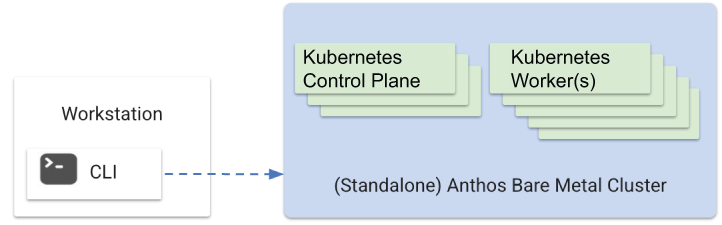
Use the deployment diagram to distinguish the combined admin-and-user topology from multicluster and hybrid arrangements. section 17.2.1
