A Standard plan runs a Logic App or Azure Functions workload on dedicated capacity. You pay for that capacity whether executions are busy or taking a coffee break, unlike Consumption billing. section 8.3 section 2.5
Standard hosting supports single-tenant stateful and stateless workflows. Workflows in one Logic App share processing, storage, and networking, while hosting choices determine isolation and operational flexibility. section 2.2.9 section 8.3
Common Standard hosting choices include:
- Workflow Standard, optimized for Logic Apps while also supporting Azure Functions. section 8.3
- App Service plans, which provide familiar dedicated hosting tiers. section 8.3
- App Service Environment and App Service Environment v3, for isolated workloads and network isolation at scale. section 8.3
- Hybrid hosting, which keeps infrastructure under your control while Azure manages deployment and the control plane. section 8.3
Choosing hosting for an image workflow
For an image-processing Logic App that connects Azure services with a third-party service, open the Azure Portal, select Standard, and choose the hosting variation that matches the required capacity, isolation, and network arrangement. Consumption remains the alternative when paying per execution is more suitable. section 8.3 section 2.2.9
Figure 8.10 The Logic App plan types
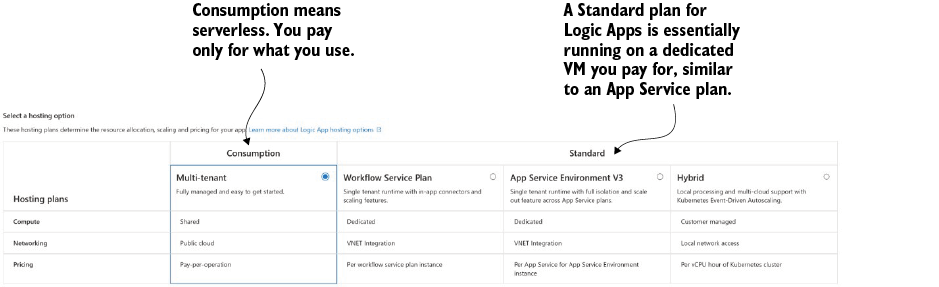
Compare the Logic App hosting plan types before choosing dedicated Standard capacity or execution-based Consumption billing. section 8.3
