Static shared memory reserves a shared array whose size is fixed at compile time, such as `__shared__ int sdata[256]`. Threads in a block can use it to stage data for cooperative work. section 5.11 section 11.14
Staging values for a reduction
Each thread copies its input into its own `sdata` slot, then the block synchronizes before reducing. With six inputs and four threads per block, the second block stages `[data[4], data[5], 0, 0]`; zero safely pads the unused slots for addition. section 5.11
Keep the array size aligned with the launch:
- If a 256-element array is used with 512 threads, some threads write out of bounds; with fewer threads, slots go unused. Use one shared constant for the declaration and launch, or use dynamic shared memory sized at launch. section 5.25 section 11.2
Figure 5.4 Act 1 (Load): staging data in shared memory for fast access. Each thread reads one value from slow global memory into its private register, then writes it to shared memory, a two-step relay that happens in parallel across all eight threads simultaneously. Once sdata is populated, the reduction can run entirely on-chip without touching global memory again.
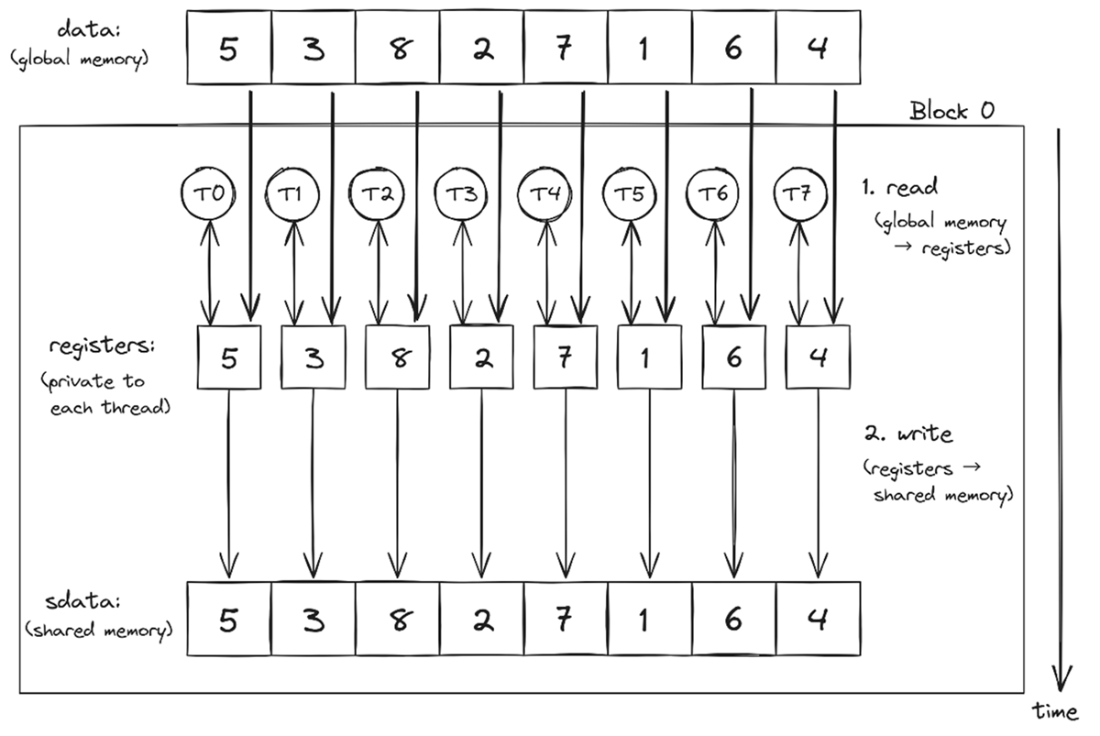
Shows threads loading global-memory values into shared memory before the reduction. section 5.11
