A steering vector controls model behavior during inference by modifying activation-based decoding guidance. It directs reasoning toward more effective paths without requiring the ML engineer to manage preprocessing. section 15.2
AutoThink operationalizes steering vectors in two phases:
- Preprocessing collects query-response pairs, identifies pivotal tokens affecting reasoning quality, derives vectors, and trains a query-complexity classifier. section 15.2
- Inference selects a reasoning budget, applies control vectors during decoding, and generates the final response after reaching that budget. section 15.2 section 15.5
- OptiLLM downloads the pretrained classifier automatically on first use, keeping vector preparation and classification transparent to the implementer. section 15.2
Adaptive reasoning on GSM8K
A Qwen 2.5 0.5B Instruct model can be evaluated on GSM8K samples with OptiLLM’s AutoThink decoder. AutoThink classifies query complexity, chooses a token budget, steers decoding, and supports evaluation on a small VM, although a GPU speeds testing. section 15.2
Figure 15.2 The two AutoThink phases (preprocessing and inference)
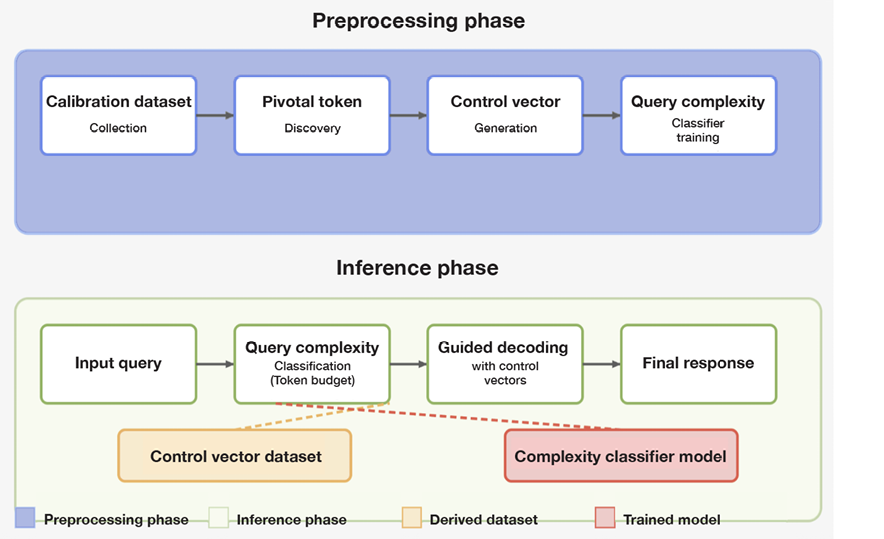
Trace how preprocessing produces steering assets and how inference applies them alongside query-complexity classification and budget selection. section 15.2
