A step response is the output produced when a system is suddenly given a constant target, such as switching a heater toward a desired temperature. In PID tuning, it reveals how quickly and smoothly the system approaches that target. section 8.7
Evaluate a step response using measures that capture different performance concerns:
- Rise time measures how quickly the output approaches its target; settling time measures how long it takes to stabilize. section 8.7
- Overshoot and steady-state error expose unwanted excursions and failure to reach the desired value. section 8.7
- ITAE, ITSE, IAE, and ISE convert error over time into optimization objectives, with different penalties for duration and magnitude. section 8.7
Python evaluation
A transfer function can be simulated with control.step_response(T), plotted against time, and summarized with control.step_info(T). The reported values can include rise time 0.353, settling time 0.52, zero overshoot, and steady-state value 1.0. section 8.7
Figure 8.18 Step response of a system. The heater is turned on or off according to the difference between the actual temperature and the desired value.
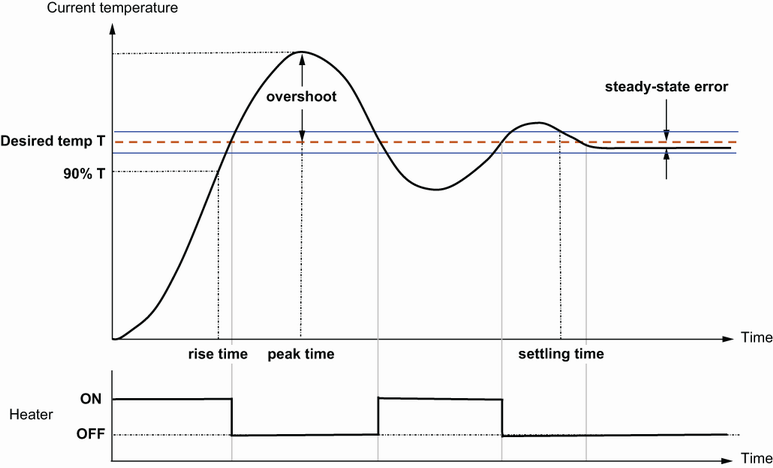
Use the heater example to connect an abrupt control action with the resulting temperature trajectory. section 8.7
