liveBook · Manning

Stereoisomer

As explained in Build AI Drug Discovery Pipelines

A stereoisomer is a compound with the same molecular formula and connectivity as another compound but a different spatial arrangement of atoms.

A stereoisomer has the same molecular formula and atomic connectivity as another compound but a different three-dimensional arrangement of atoms. This distinguishes stereoisomers from constitutional isomers, which differ in connectivity. section 1.2.1

A stereocenter is an atom where exchanging two groups creates another stereoisomer. Chirality describes structures that cannot be superimposed on their mirror images; tetrahedral carbon with four different substituents can form chiral centers. section 1.2.1

Thalidomide

R-thalidomide produced the intended therapeutic effect, while S-thalidomide caused severe birth defects. Their biological effects demonstrate why identical formulas and connectivity do not guarantee identical drug behavior; rapid racemization makes the example more complex than a simple good-versus-bad pair. section 1.2.1

Figure 1.3 Example pairs of isomeric SMILES.
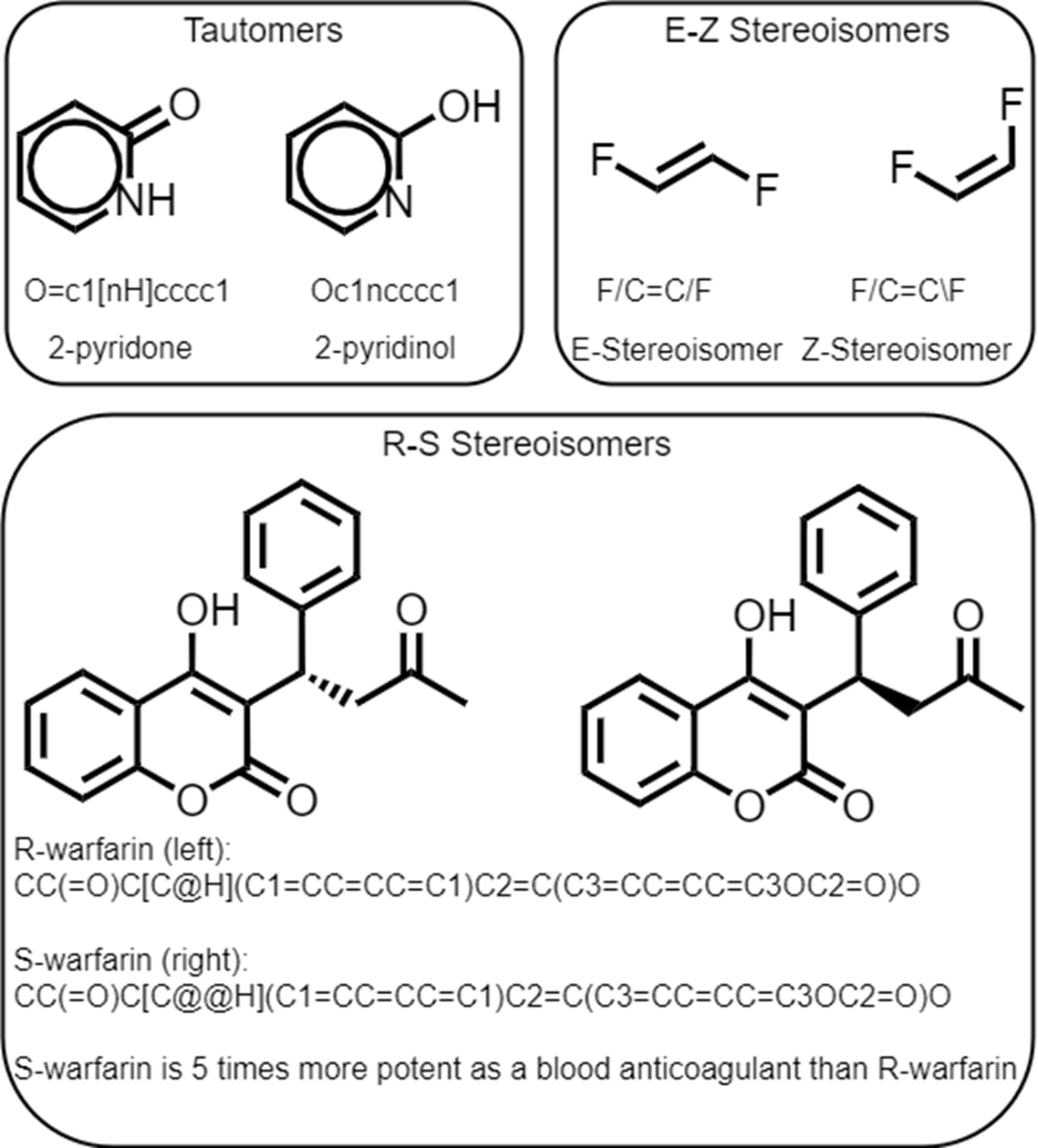
Compare paired isomeric SMILES to connect molecular representations with stereoisomers that share connectivity but differ spatially. section 1.2.1

How Build AI Drug Discovery Pipelines covers it

How deep it goes
Defines stereoisomers, stereocenters, and chirality, then illustrates consequences through thalidomide; it does not develop stereochemical algorithms.
Examples
Uses chiral hands, tetrahedral carbon, thalidomide enantiomers, and paired isomeric SMILES as concrete illustrations.
What it assumes
Builds from molecular formula and atomic connectivity before introducing stereocenters, mirror-image chirality, and spatial arrangement.
What you can do after
Evaluate why molecules with identical formulas and connectivity can produce dramatically different biological effects.
How it connects
Connects stereoisomers with molecular formula, connectivity, constitutional isomers, stereocenters, chirality, enantiomers, SMILES, and racemization.

This explainer was generated by Manning's knowledge graph from the text of Build AI Drug Discovery Pipelines. The section links point to the parts of the book it draws on.