Stigmergic communication coordinates social organisms indirectly through changes to their environment. Ants primarily use pheromone trails: a discovered food source modifies a path, and that modification guides later activity. section 10.1
Individual ants are simple stimulus-response organisms that cannot accomplish complex tasks alone. Colonies can nevertheless perform complex work without planning, centralized supervision, a central controller, or direct communication. section 10.1
The mechanism is illustrated by a simple feedback pattern:
- A foraging ant deposits pheromone along its return path. section 10.1
- Other ants preferentially follow paths with stronger pheromone trails to reach the food source. section 10.1
Figure 10.1 Ant foregoing process. A foraging ant deposits a pheromone trail along the path it takes on its way back to the nest. Other ants will likely follow the path with a stronger pheromone trail to reach the discovered food source.
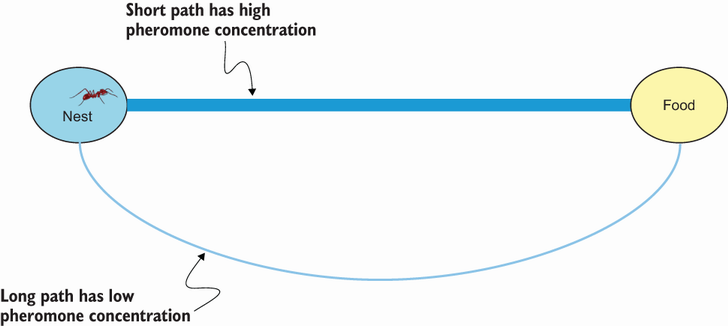
Trace how one ant’s pheromone trail changes the environment and attracts subsequent foragers. section 10.1
Figure 10.2 a) Binary bridge experiment; b) bridges with non-equal lengths experiment
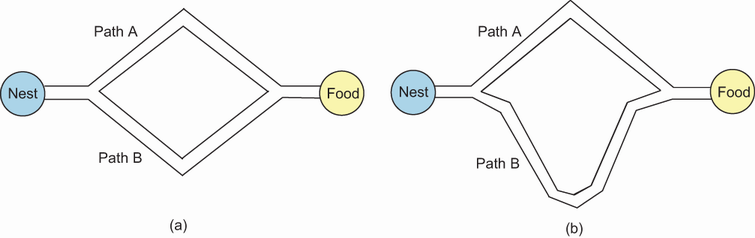
Compare binary and unequal-length bridge experiments as concrete demonstrations of collective path selection. section 10.1
