A stochastic policy assigns probabilities to selecting available actions given a state or observation. Unlike a deterministic policy, it can choose different actions in the same situation. The policy may be parameterized, with weights and biases adjusted to change behavior through optimization. section 12.1.2
A stochastic policy supports two useful views:
- As a decision rule, it maps states or observations to action probabilities. section 12.1.2
- As a parameterized function, it uses adjustable parameters such as neural-network weights and biases. section 12.1.2
Reach the Treasure
In a four-state game, an agent starts in state 2 and chooses left or right. Moving toward the treasure can produce +10, falling into a fire pit produces −10, and exiting successfully produces +4. A stochastic policy represents the probabilities of choosing each move from the current state. section 12.1.2
Figure 12.4 Reach the Treasure game
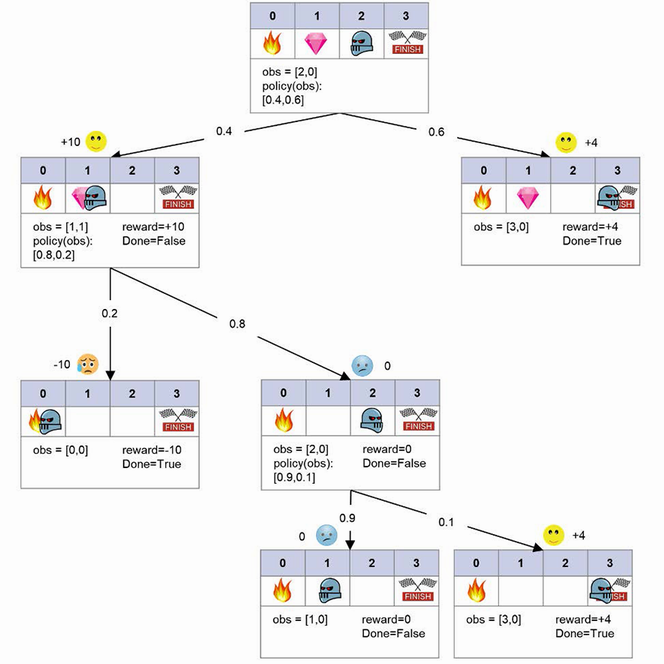
Use the Reach the Treasure diagram to trace states, actions, terminal outcomes, and the policy’s decision points. section 12.1.2
