A storage class is a service-defined tier that determines how stored data balances performance, availability, durability, accessibility, and cost. AWS services expose different classes for different access patterns: S3 offers archival tiers, while EFS offers classes for frequent, infrequent, or single-zone access. section 7.4 section 9.1.2
Choose a storage class by evaluating:
- Access frequency: EFS Standard or One Zone provides low latency for frequent access; infrequent-access classes reduce storage cost but add access charges and first-byte latency. section 9.1.2
- Availability requirements: EFS One Zone classes avoid replication across multiple data centers, reducing the availability objective from 99.99% to 99.9%. section 9.1.2
- Retrieval urgency: S3 Glacier classes lower storage prices but make retrieval expensive or delayed, with delays ranging from minutes to 48 hours. section 7.4
- Performance: EFS Standard reads can have latency as low as 600 microseconds, whereas One Zone can increase read and write latency to double-digit milliseconds. section 9.5.3
Archive and restore an S3 object
Upload an object with the GLACIER storage class using the AWS CLI. The object cannot be downloaded immediately. Request a temporary restore, inspect the restoration status with head-object, and download it after restoration completes. Glacier Flexible Retrieval can reduce storage costs substantially, but restoration and retrieval incur costs. section 7.4
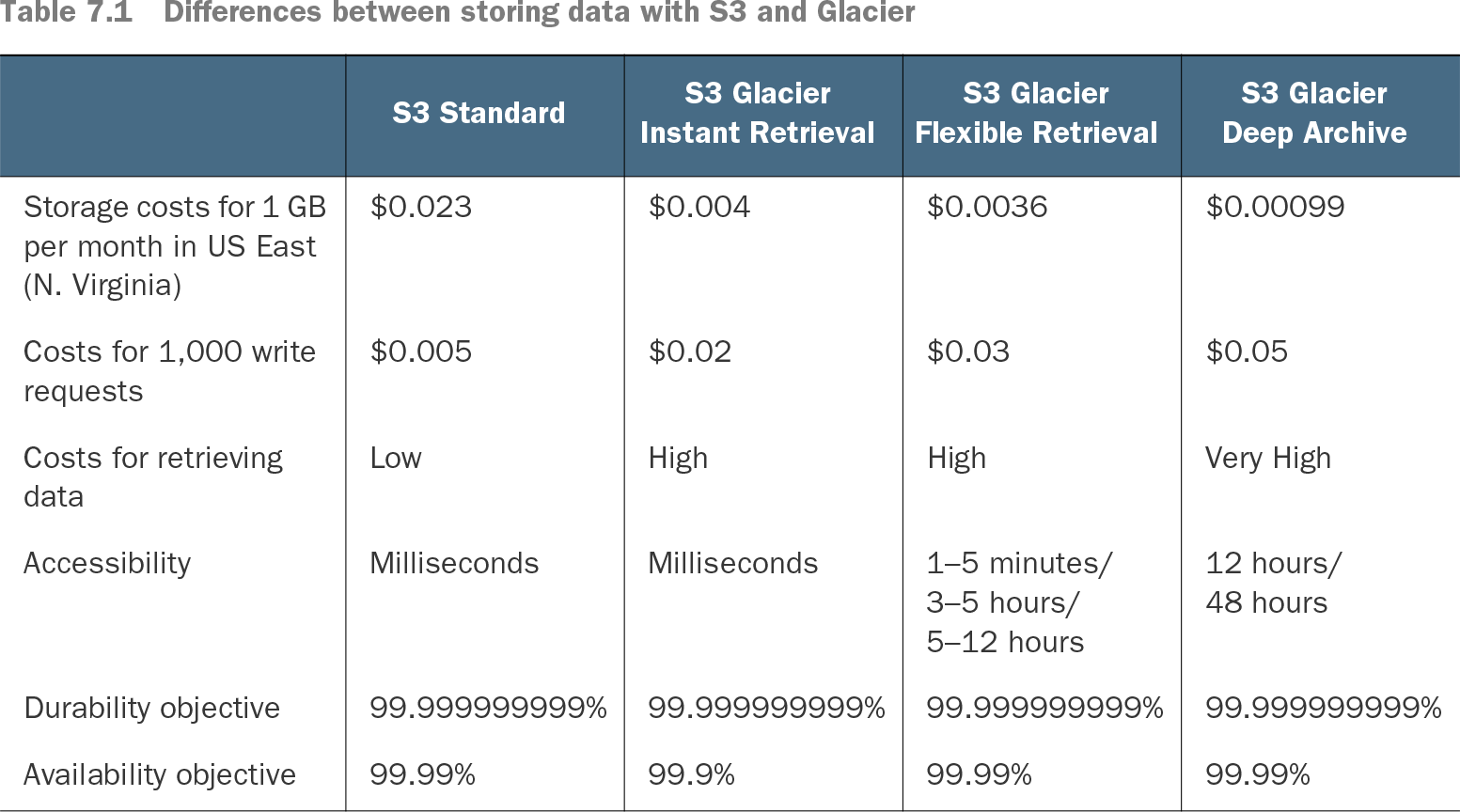
Table 7.1 Differences between storing data with S3 and Glacier (view table figure)
Compare S3 Standard with Glacier Instant Retrieval, Glacier Flexible Retrieval, and Glacier Deep Archive across monthly storage price, request cost, retrieval cost, accessibility, durability, and availability. section 7.4