liveBook · Manning

Story card

As explained in Delivering Machine Learning Projects: From design to deployment

A story card is a structured artifact that records an application or model story, its organizational impact, relevant data, constraints, and intended use.

A story card turns a user or model story into a shared design artifact: it records the application concept, organizational impact, relevant data, constraints, intended use, and unresolved issues. section 5.3

Build the card around these delivery questions:

  • What concept and business priorities does the project address? section 5.3
  • Who are the stakeholders, and how will the solution affect the organization? section 5.3
  • What data supports the model, and why is the proposed approach expected to work? section 5.3
  • Which functional, nonfunctional, usage, and risk constraints determine whether the output is useful? section 5.3
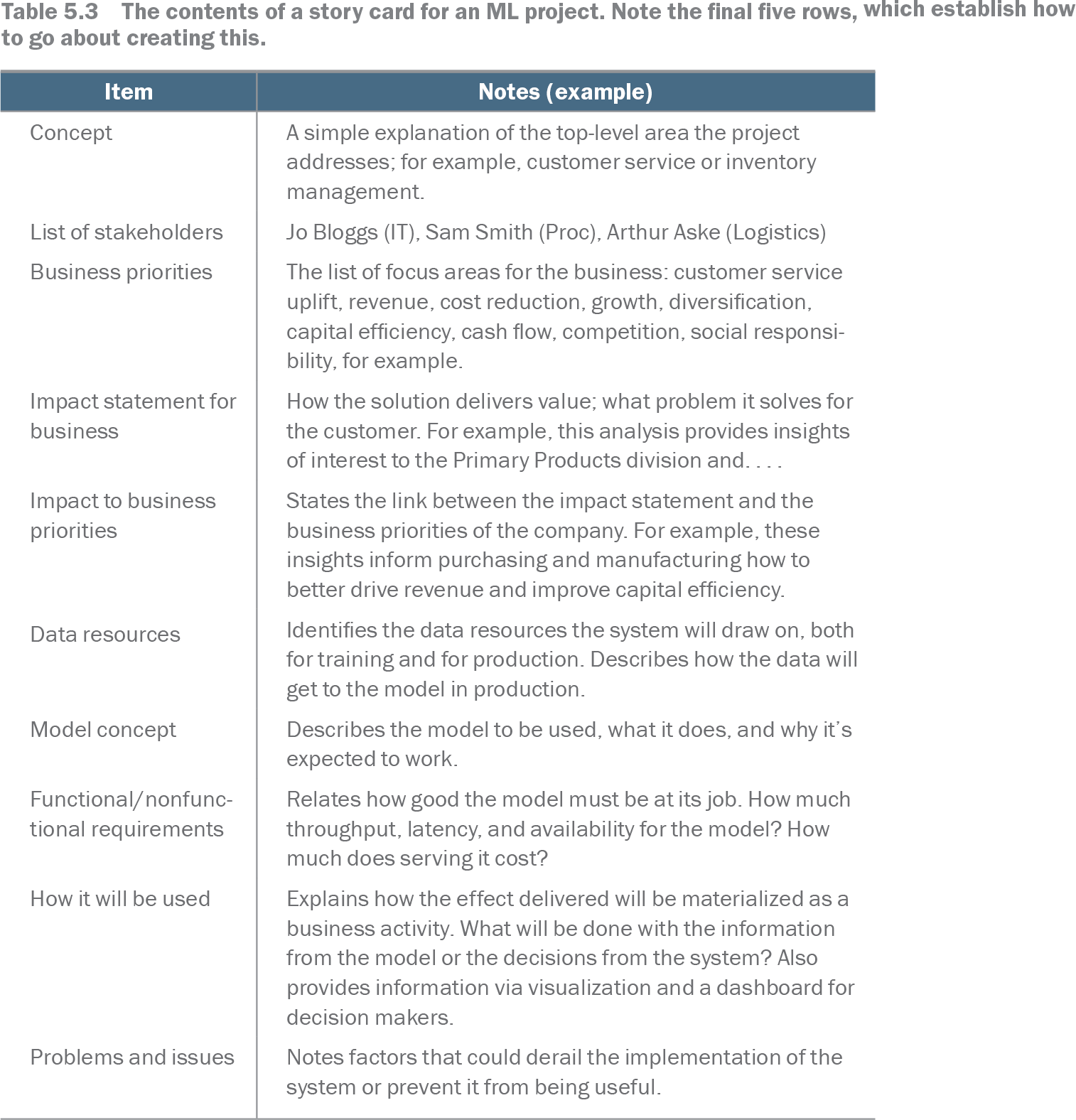
Table 5.3 The contents of a story card for an ML project. Note the final five rows, which establish how to go about creating this. (view table figure)

Item

Notes (example)

Concept

A simple explanation of the top-level area the project addresses; for example, customer service or inventory management.

List of stakeholders

Jo Bloggs (IT), Sam Smith (Proc), Arthur Aske (Logistics)

Business priorities

The list of focus areas for the business: customer service uplift, revenue, cost reduction, growth, diversification, capital efficiency, cash flow, competition, social responsibility, for example.

Impact statement for business

How the solution delivers value; what problem it solves for the customer. For example, this analysis provides insights of interest to the Primary Products division and. . . .

Impact to business priorities

States the link between the impact statement and the business priorities of the company. For example, these insights inform purchasing and manufacturing how to better drive revenue and improve capital efficiency.

Data resources

Identifies the data resources the system will draw on, both for training and for production. Describes how the data will get to the model in production.

Model concept

Describes the model to be used, what it does, and why it’s expected to work.

Functional/nonfunctional requirements

Relates how good the model must be at its job. How much throughput, latency, and availability for the model? How much does serving it cost?

How it will be used

Explains how the effect delivered will be materialized as a business activity. What will be done with the information from the model or the decisions from the system? Also provides information via visualization and a dashboard for decision makers.

Problems and issues

Notes factors that could derail the implementation of the system or prevent it from being useful.

Use the story-card table as a checklist for concepts, stakeholders, priorities, business impact, data, requirements, use, and problems. section 5.3

How Delivering Machine Learning Projects: From design to deployment covers it

How deep it goes
Specifies organizational context, data rationale, functional and nonfunctional requirements, intended use, and problems to investigate.
Examples
Uses customer service and inventory management concepts, stakeholder lists, business priorities, impact statements, model data, and usage constraints.
What it assumes
Assumes a project hypothesis, sprint-0 roadmap, and preliminary user or model stories that can be developed with experts and users.
What you can do after
Build it from scratch by formalizing stories into a feasible ML application concept with explicit value, requirements, usage, and risks.
How it connects
Connects user stories, model stories, application design, functional requirements, nonfunctional requirements, and machine learning business value.

Related concepts

This explainer was generated by Manning's knowledge graph from the text of Delivering Machine Learning Projects: From design to deployment. The section links point to the parts of the book it draws on.