liveBook · Manning

Stream processing system

As explained in Apache Kafka in Action

A stream processing system is software that operates directly on continuously arriving data streams.

A stream processing system operates directly on continuously arriving data streams, allowing connected enterprise systems to evaluate and manipulate data in near real time. section 4.4

Typical stream-processing operations include:

Kafka-based implementations include Kafka Streams, Apache Flink, and Scala’s Akka. Stream-processing libraries support scalable and robust processing on large data sets, while some commercial offerings avoid programming. section 4.4

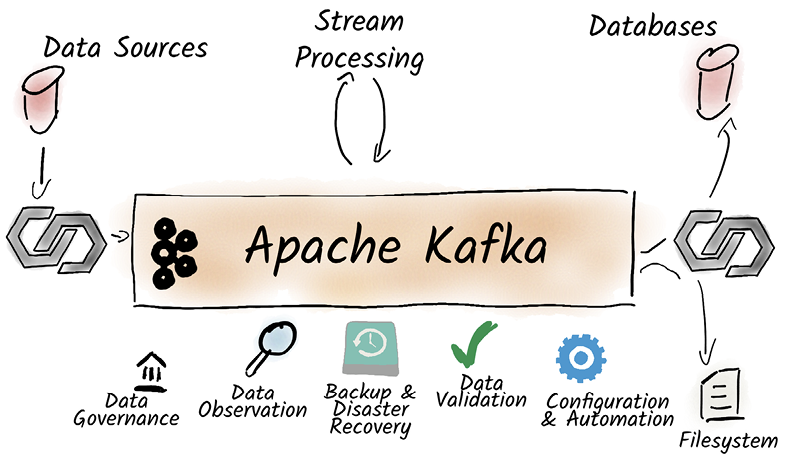
Figure 4.12 Kafka alone is usually not enough. The Kafka ecosystem offers numerous components to integrate Kafka into our enterprise landscape and thus build a streaming platform.
A screen shot of a computer

AI-generated content may be incorrect.

Shows how stream processing fits within a broader Kafka streaming platform alongside enterprise integration components. section 4.4

How Apache Kafka in Action covers it

How deep it goes
Defines stream processing and names filtering, manipulation, and joins, but does not detail implementation internals or procedures.
Examples
Uses filtering, individual-record manipulation, and joins between data streams as representative operations.
What it assumes
Assumes data already flows through Kafka and connected systems, while presenting stream processing as the mechanism for working on those streams.
What you can do after
Build scalable stream-processing operations with Kafka Streams, Apache Flink, Akka, or comparable libraries.
How it connects
Connects Kafka with Kafka Streams, Apache Flink, Akka, Kafka Connect, REST proxies, and schema management.

Related concepts

This explainer was generated by Manning's knowledge graph from the text of Apache Kafka in Action. The section links point to the parts of the book it draws on.