liveBook · Manning

Streaming multiprocessor

As explained in Grokking GPU Programming

A streaming multiprocessor is a GPU hardware unit that schedules and executes groups of GPU threads using its execution resources.

A streaming multiprocessor (SM) is a GPU unit that runs CUDA threads. The hardware assigns each block to one SM; the SM runs its threads in groups of 32 called warps. CUDA cores inside the SM do the arithmetic. section 2.8 section 3.16

An eight-thread launch

Launching eight threads still uses one 32-thread warp: eight lanes do work and 24 are idle. You launch threads; the hardware packs them into warps. section 2.8

A GPU contains many SMs, and each can run many warps. Blocks run on one SM from start to finish; extra blocks wait their turn. Warp scheduling details are covered later. section 2.8 section 3.16

Figure 2.5 The containment hierarchy and where it runs. A kernel launch creates a grid; the grid contains blocks; each block’s threads are packed into warps of 32; and each block is assigned to an SM, whose cores execute those warps. Software on the left, hardware on the right.
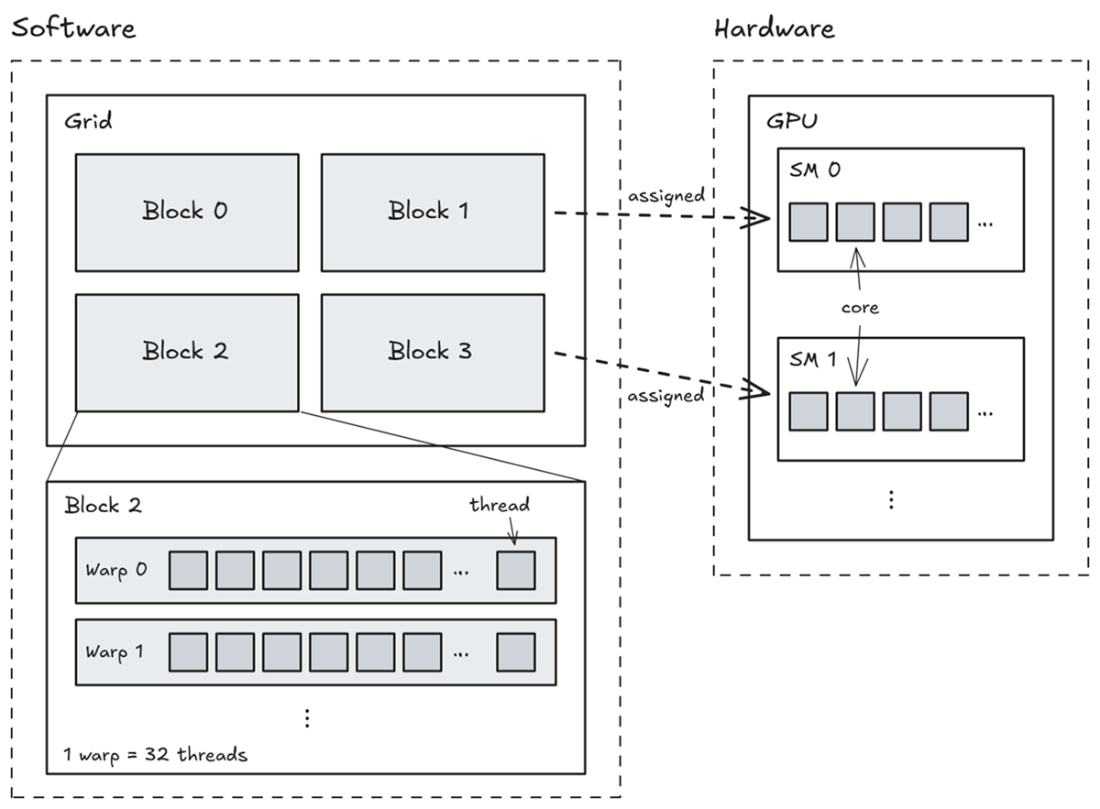
Trace the path from a kernel launch through its grid, blocks, warps, and SMs. section 2.8


How Grokking GPU Programming covers it

How deep it goes
Defines SMs within the GPU and identifies warps and CUDA cores, while deferring warp-scheduling details.
Examples
Uses an eight-thread launch to show 24 idle lanes in a 32-thread warp.
What it assumes
Assumes basic C, including functions, loops, and some pointer familiarity, while introducing the CUDA execution hierarchy.
What you can do after
Understand how launched blocks are assigned to SMs and how threads are grouped into warps.
How it connects
Connects CUDA blocks, warps, threads, CUDA cores, and SIMT execution.

Also explained in

Compare how 2 books explain streaming multiprocessor →

Related concepts

This explainer was generated by Manning's knowledge graph from the text of Grokking GPU Programming. The section links point to the parts of the book it draws on.