Strong consistency guarantees that all clients observe updates in the same order and see completed changes immediately across replicas. This behavior is also called linearizability. section 6.7
Consensus helps provide this guarantee by making distributed nodes agree on one value or decision despite failures or network partitions. It supports leader election, replication, recovery, and distributed query execution. section 6.6
Conflicting writes
If one request sets foo=42 on node 1 while another sets foo=200 on node 2, consensus ensures every node settles on the same value rather than returning conflicting results. section 6.6
Strong consistency makes two questions explicit:
- Order: Do all users observe concurrent updates in the same sequence? section 6.7
- Visibility: Do other clients see an update immediately, or can replica synchronization delay it? section 6.7
- Trade-off: Coordinating replicas increases overhead and can reduce performance compared with weaker models such as eventual consistency. section 6.7
- Do not confuse consistency models, which describe behavior across replicas, with isolation levels, which describe interaction among concurrent transactions within one database. section 6.7
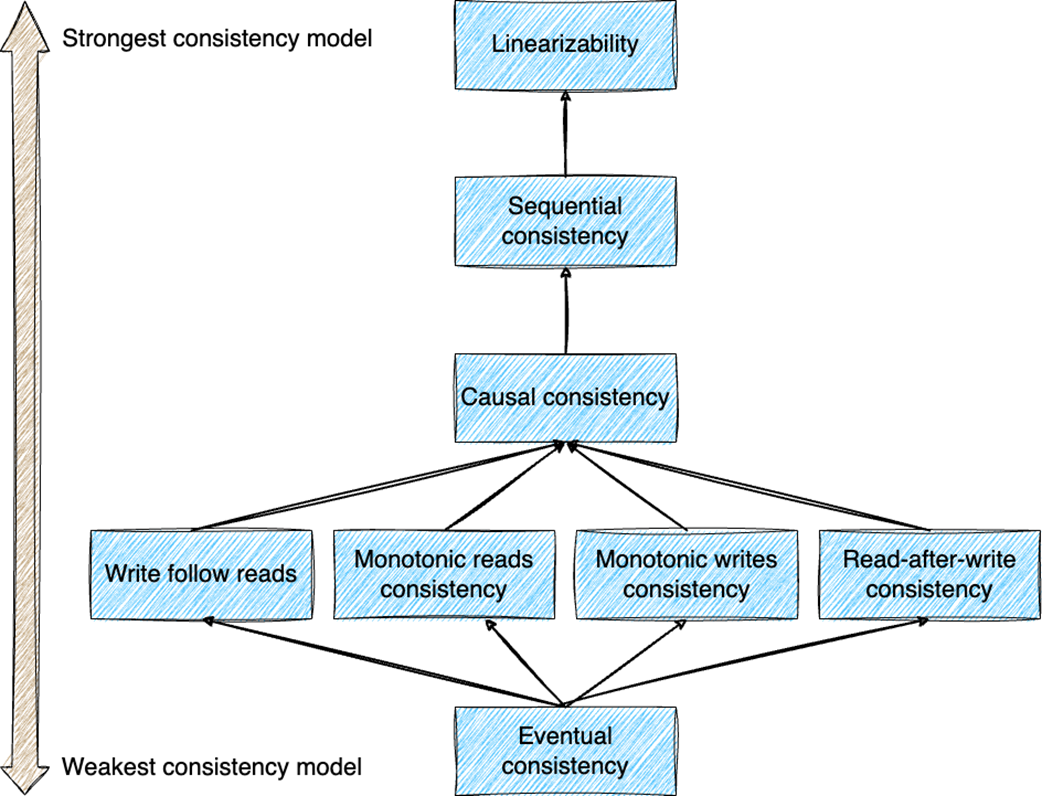
Compare how users observe concurrent updates by tracing their order and visibility across replicas. section 6.7



