Type safety enforces compatibility between values and their types instead of freely coercing incompatible values. TypeScript adds static typing and type safety checks to JavaScript, validating them before execution and transpiling the result to JavaScript. section 5.1
Type safety supports TypeScript development by:
- Reducing runtime errors while improving reliability, scalability, maintainability, and collaboration on larger codebases. section 5.1
- Covering an entire application rather than only component properties, including hooks, functions, and external-library usage. section 4.3.2
- Requiring deliberate typing for React state, refs, contexts, effects, reducers, callbacks, memoization, and generic components. section 6.5
Typing React APIs can expose invalid state updates, mutable-reference mistakes, invalid effect returns, and unsuitable reducer transitions before runtime. Generic reducers and components increase reuse but may require extra type arguments and create friction with forwardRef and memo. section 6.5
Property-based validation is narrower and later: it reports errors at runtime, covers components rather than the whole codebase, and is ignored by React 19. TypeScript therefore provides the broader safety boundary. section 4.3.2
Figure 5.1 TypeScript contains all the features that JavaScript does, including variables, functions, classes, and statements. It also contains new features, including types, enums, interfaces, and generics.
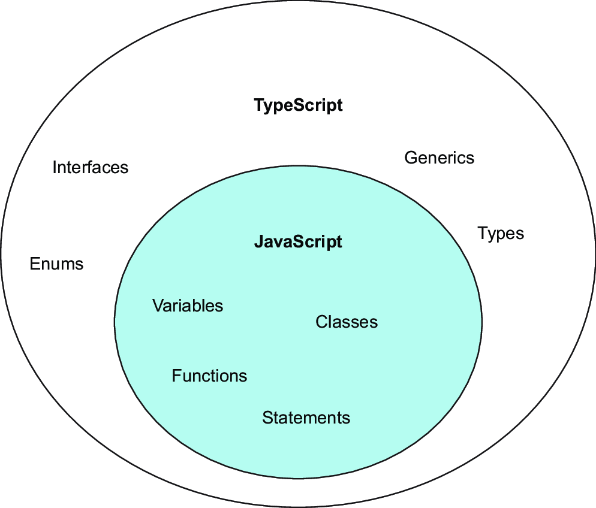
Use the feature map to locate TypeScript’s type-oriented additions alongside JavaScript variables, functions, classes, and statements. section 5.1







