Structured knowledge-based search retrieves text through formalized domain knowledge and ontology relationships rather than relying only on matching query terms. It connects related information across documents and can expose relationships that conceptual search misses. section 7.4.2 section 7.7.2
A typical search pipeline:
- Resolve a query entity, such as Islets of Langerhans, against a medical knowledge graph. section 7.7.2
- Navigate selected ontology relationships to obtain related entities, such as diseases affecting that entity. section 7.7.2
Pancreatic-islet search
Starting from Islets of Langerhans, a FINDING_SITE path retrieves text about hyperglycemia and diabetes mellitus. This reaches donor-maintenance information that a conceptual keyword search would not retrieve. section 7.7.2
Figure 7.14 Differences between conceptual search and structured knowledge-based search. In this case, the search process involves medical entities connected by ontology relationships to the entity detected in the search query. Starting from the “islets of Langerhans” search, the system searches for “diabetes type 1” and “hyperglycaemia,” which are two diseases that can affect the islets of Langerhans.
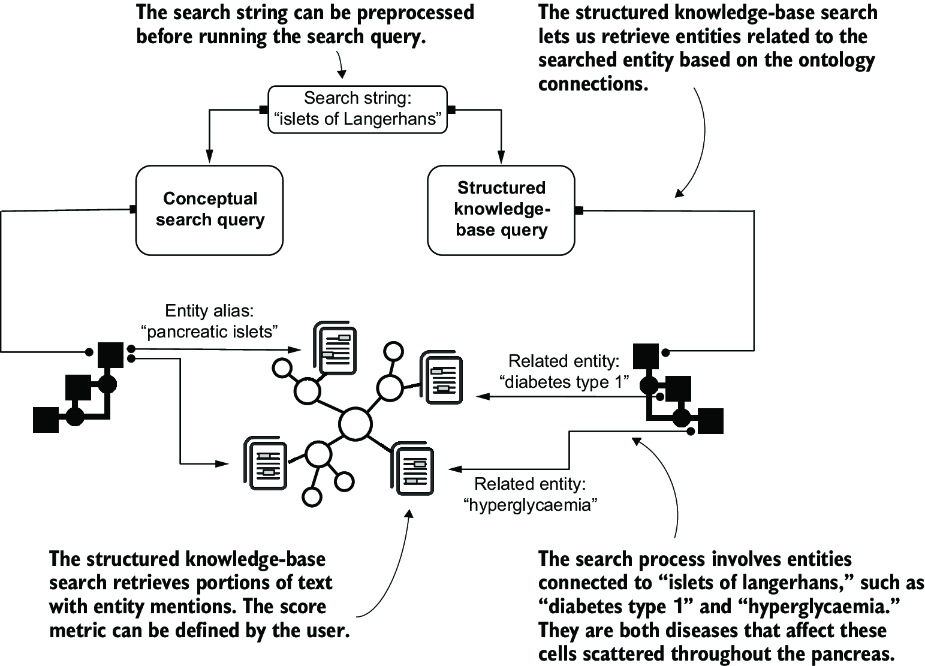
Compare conceptual search with ontology-driven expansion from a detected medical entity to connected diseases. section 7.7.2
