Style transfer transforms an image by applying stylistic characteristics from one source while preserving the target image’s content. It supports creative editing, marketing visuals, personalization, and product design. section 4.1 section 4.1.1
Image-generation architectures approach the technique in related ways:
- Variational autoencoders learn a latent representation that separates content from style, allowing stylistic elements to move between images. section 4.1.1
- Generative adversarial networks transpose artistic styles while training a generator to produce images realistic enough to fool a discriminator. section 4.1.2
- Production evaluation should account for controllability, blur, diversity, mode collapse, instability, bias, privacy, misinformation, and misrepresentation risks. section 4.1.1 section 4.1.2
Artistic transformation
A photograph of the Seattle Space Needle can be rendered as an oil painting in the style of Vincent van Gogh, retaining the scene while changing its visual character. section 4.1 section 4.1.1
Figure 4.2 An oil painting of the Seattle Space Needle in the style of Vincent Van Gogh
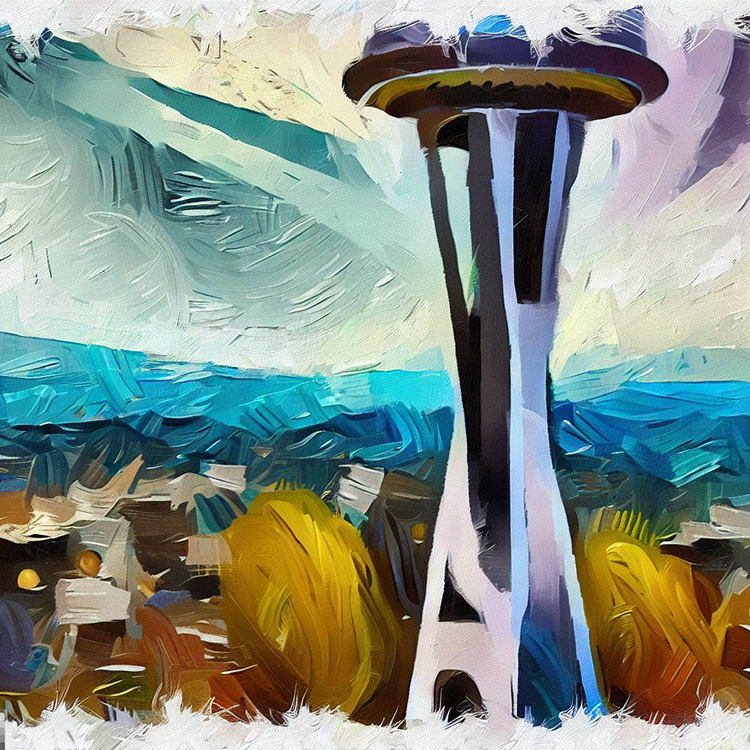
View the oil-painting transformation to compare preserved subject matter with transferred artistic style. section 4.1
