A subdomain is a slice of business functionality within an application, typically owned by a small team. It organizes the code responsible for a coherent business area, rather than a technical role such as persistence or user interface. section 3.2.1 section 6.2.1
In the domain view, subdomains contain programming elements and can use one another. A system operation may start in one subdomain and collaborate with others. In an object-oriented application, a subdomain can contain classes organized into a package hierarchy. section 3.2.1
Creating an order
Order Management handles createOrder(), uses Consumer Management to verify that the consumer exists and can place orders, and uses Delivery Management to schedule delivery. Each subdomain has its own responsibility and business entities. section 3.2.1
A subdomain is not itself a deployable unit. A service contains one or more subdomains; a subdomain can also be a shared library used by multiple services. In a monolith, subdomains are packaged and deployed together. A layered monolith can scatter each subdomain’s code across web, domain, and persistence layers, creating a mismatch with team responsibilities. section 7.2.2 section 6.2.1
Consider subdomain characteristics when deciding how to package and deploy functionality:
- Resource requirements: subdomains in the same service scale together, potentially overprovisioning resources for some of them. section 7.4.5
- Business criticality and security: separating subdomains into services can isolate critical functionality or sensitive data. section 6.1.3
- Regulations and domain-driven design type: subdomains can also differ in development regulations and in whether they are core, supporting, or generic. section 7.4.5
Scaling different workloads
Order Management needs ten instances, while GPU-based Fraud Detection needs only five. If both are packaged in one service, ten instances are provisioned together. Separate services allow each subdomain to scale independently and can reduce resource waste. section 7.4.5
Figure 7.7 Subdomains within the same service are scaled together, which can require over-provisioning of some resources. Putting them in separate services enables them to be scaled independently which improves resource utilization and reduces cost.
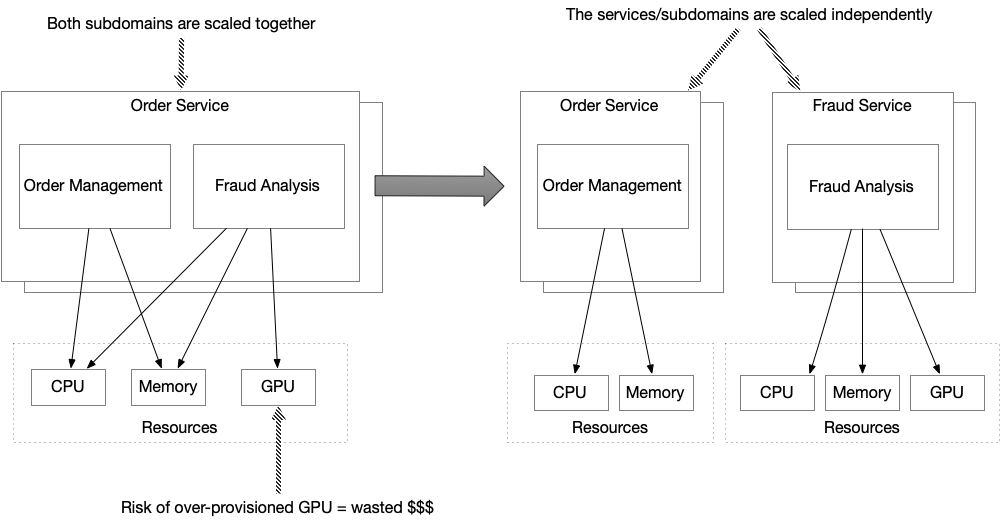
Compare scaling subdomains together in one service with scaling them independently in separate services. section 7.4.5
Use subdomains to make business responsibilities and team ownership visible, then choose deployment boundaries based on concrete needs. Separate services can provide isolation and independent scaling, but a service may contain multiple subdomains; use the simplest architecture that addresses the actual problem. section 3.2.1 section 3.5 section 7.2.2



