A subject matter expert is a person who possesses, shapes, and extends specialized knowledge of a focused domain. In a software domain, these experts own the business knowledge that the system must represent, such as pricing, processes, or regulatory compliance. section 1.4
Domain expert is the working term for a subject matter expert in a domain-specific language (DSL) approach. Experts share a domain-specific ubiquitous language, then help turn its concepts and terms into precise DSL content. section 1.2 section 1.4
A subject matter expert contributes by:
- Writing a precise software specification in a Domain IDE instead of relying on developers to translate every business detail manually. section 1.3.1
- Using guided DSL editing to create valid, understandable, and maintainable content. section 1.2
- Changing features and testing the resulting Runtime independently, while software developers provide the Domain IDE and supporting implementation. section 1.3.1 section 1.5
Car-rental domain
Employees responsible for computing price quotes, executing business processes, and safeguarding regulatory compliance act as subject matter experts. Their shared business knowledge can become DSL content precise enough to generate parts of the car-rental Runtime. section 1.4 section 1.2
Figure 1.2 Using a DSL-based approach to develop a Runtime using a Domain IDE
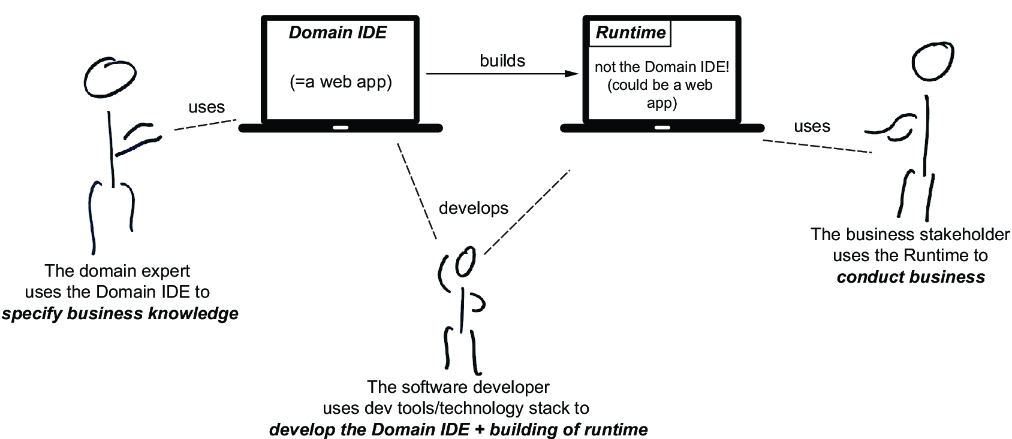
Shows how subject matter experts use a Domain IDE to author DSL content that contributes to a generated Runtime. section 1.2



