A substantial modification changes an AI system’s compliance or intended purpose in a way its original provider did not foresee. The modifier may become the provider of the changed system. section 7.3.2
From recommendations to automatic approvals
A bank uses a credit-scoring tool designed to support decisions reviewed by credit officers. If its engineers add a browser extension that automatically approves applications above a threshold, they have changed the system’s operation beyond what the vendor validated; the bank becomes the provider of the modified system. section 7.3.2
Assess changes against the original provider’s intended purpose and assessment:
- Changes to capabilities, data sources, deployment context, or upstream models may require reassessment when they go beyond what the original assessment covered. section 7.5.1
- Heavy fine-tuning of another provider’s deployed high-risk system can amount to substantial modification; fine-tuning alone does not automatically make someone a provider. section 7.3.6
- Document expected changes in the initial conformity assessment. Changes within that documented envelope do not count as substantial modifications. section 7.5.1
Figure 7.13 Classification and role decision tree. The tree produces two outputs: a risk classification and a role assignment. Together, they determine which obligation set applies and which evidence pack you need.
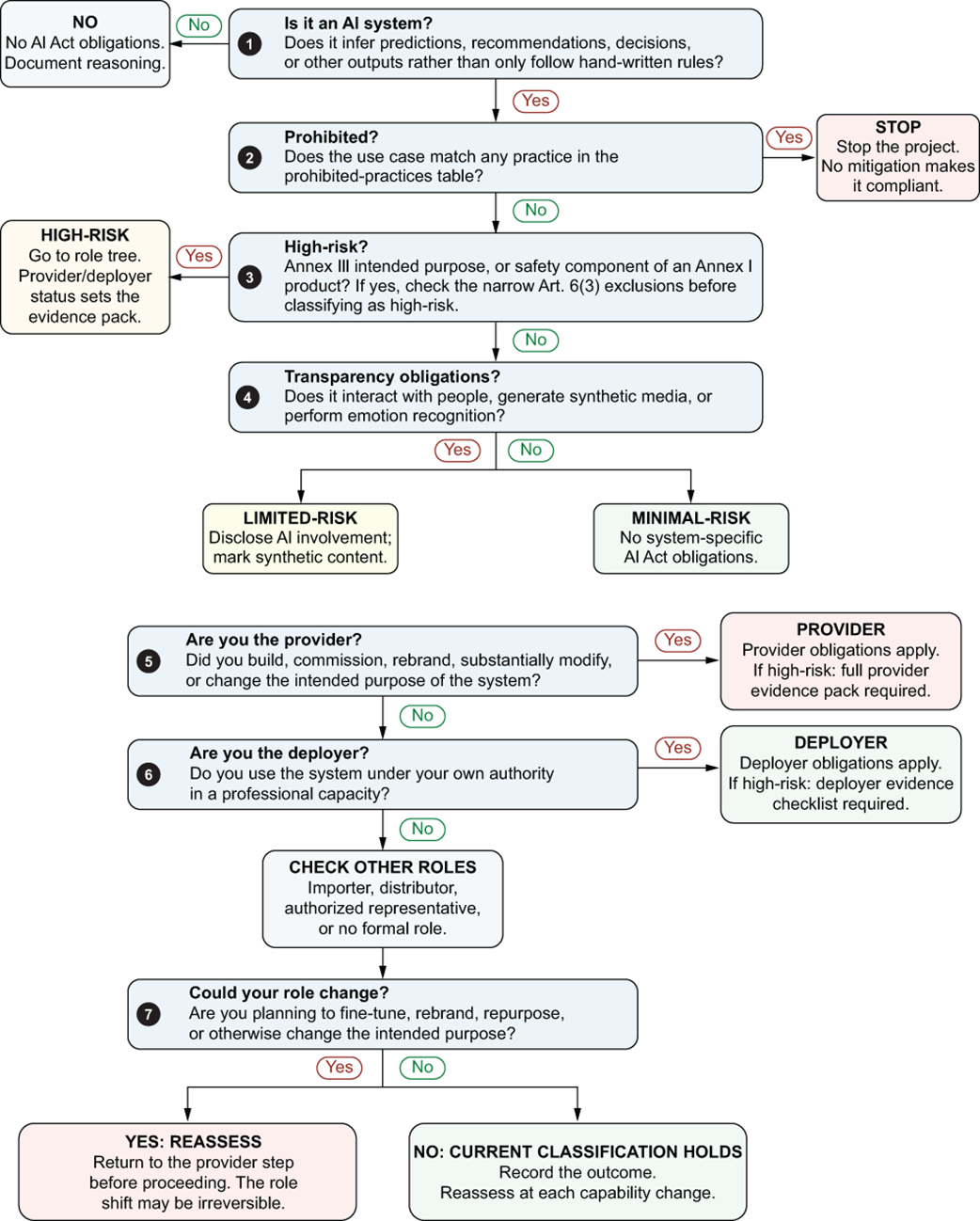
Use the decision tree to consider how a change affects risk classification and role assignment, which together determine applicable obligations. section 7.3.6
