Supervised encoding represents each category using both feature values and target labels. Unlike unsupervised encodings, it can capture how categories relate to the prediction target. section 8.1 section 8.1.3
A basic target-statistics procedure works as follows:
- Choose a categorical feature and a statistic, such as the mean target value. section 8.1.3
- Group training examples by category and compute the statistic for each group. section 8.1.3
- Replace every category with its corresponding numerical statistic; unlike one-hot encoding, this adds no columns. section 8.1.3
- Prevent leakage with hold-out, leave-one-out, or ordered target statistics rather than using every label indiscriminately. section 8.5
Encoding T-shirt color
For red T-shirts costing 8.99, 9.99, and 25.00, the mean target is 14.66. Every red value is therefore replaced by 14.66; blue and green receive their own category means. section 8.1.3
Figure 8.2 The category red of the feature color is replaced by its target statistic, the average (mean) of all the target values (cost) corresponding to the examples whose color is red. This is called greedy target encoding as all the training labels have been used for encoding.
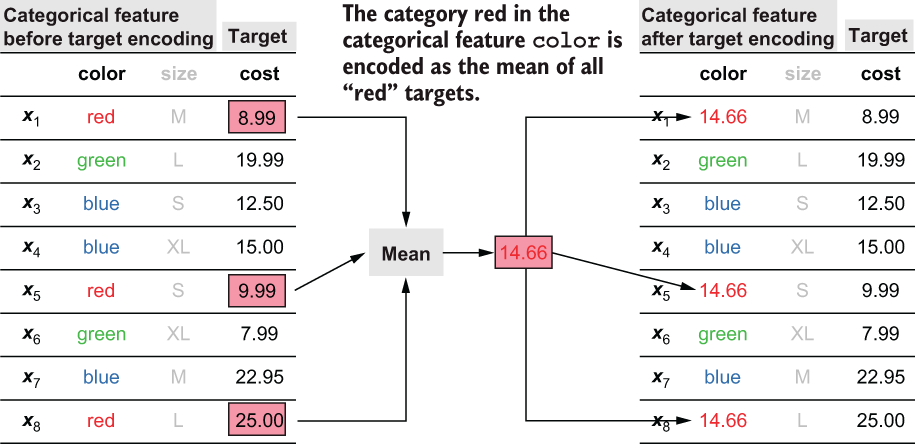
Visualizes greedy target encoding by replacing red with the mean cost of all red examples. section 8.1.3
Figure 8.5 Hold-out encoding partitions the available data into three sets: training and test, as usual, and a third hold-out test set to be used exclusively for encoding with target statistics. This avoids both target leakage and distribution shift.
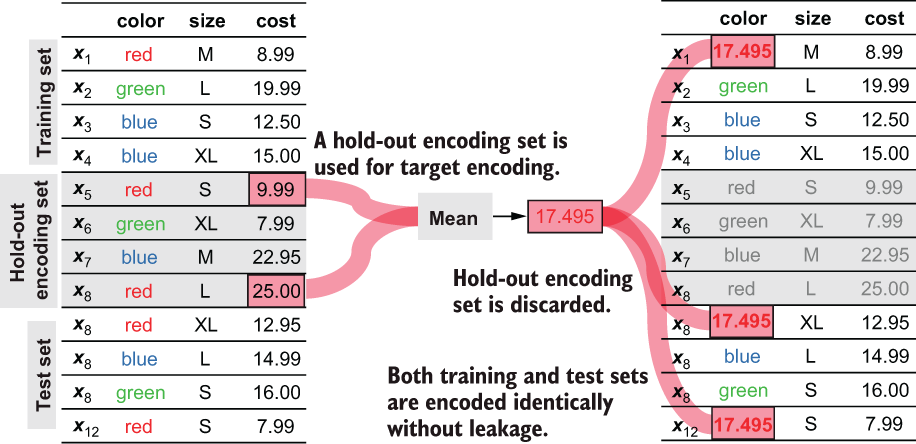
Shows how a separate encoding hold-out set avoids target leakage and distribution shift. section 8.1.3
