Supervised fine-tuning (SFT) shapes a pretrained model using examples of desired behavior. Pretraining gives a language model broad competence at predicting text; SFT makes particular responses more likely when an application needs it to follow instructions, adopt a role, or maintain an appropriate tone. section 7.1.1
Training examples are usually instruction–response pairs: a request followed by an answer written, selected, or curated by human annotators. The model predicts the answer token by token. Differences between its predictions and the target answer produce errors that update its parameters, making similar responses more likely in future. section 7.1.1
Figure 7.1 Supervised fine-tuning (SFT). The model is trained on curated instruction–response examples that represent desired behavior. During training, the model predicts the response token by token and compares its predictions with the target sequence. Errors adjust the model’s parameters so that responses resembling the reference answers become more likely in future generations.
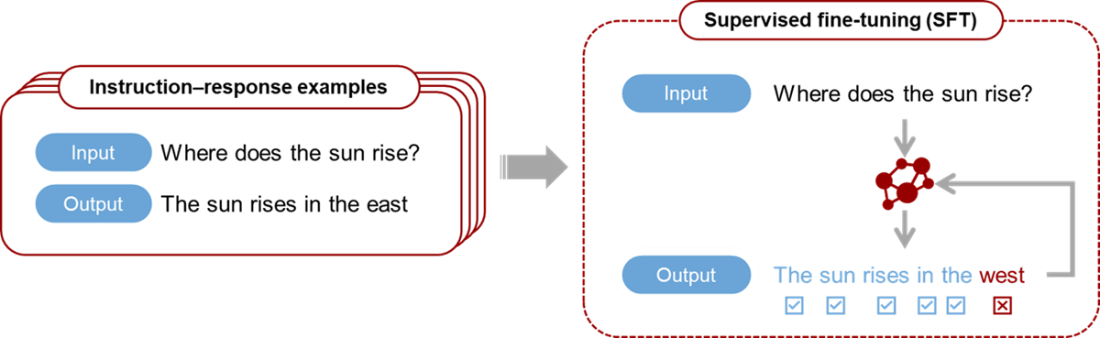
Follow how curated examples, token predictions, and parameter updates shape future responses. section 7.1.1
The examples can shape a general-purpose chatbot, coding helper, customer-support agent, tutor, or domain-specific assistant. They can also teach responses to harmful requests, such as refusing, setting boundaries, or redirecting an interaction toward a safer response. These behaviors are learned tendencies, not fixed rules or evidence of an intrinsic ethical commitment. section 7.1.1 section 7.5
Imitating a selected answer does not resolve every choice: multiple responses may satisfy an instruction while differing in helpfulness, honesty, caution, tone, or safety. Later preference-based alignment can refine behavior by comparing alternatives or applying guiding principles. SFT can also begin the shaping of reasoning models with examples that solve problems through useful intermediate steps, followed by reward-based training. section 7.1.2 section 9.2.2


