liveBook · Manning

Supply risk

As explained in Financial AI in Practice

Supply Risk is a score representing the degree of disruption or threat to the availability of goods, inputs, or production capacity described in relevant information.

Supply risk scores the likelihood that supply constraints or disruptions will affect an asset or sector. Treat the score as an evidence-backed signal, not a standalone prediction. section 11.4

A retrieval-augmented LLM process extracts the score from retrieved news and returns it with supporting evidence and reasoning in a structured format. section 11.4 section 11.5

Uranium market signal

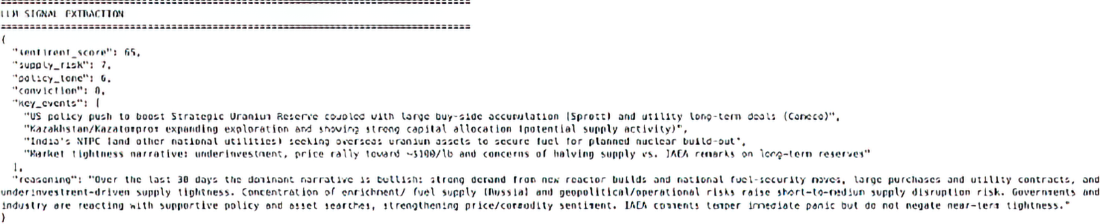
A sample assessment scores supply risk 7/10, citing geopolitical concentration in enrichment, including Russia’s role, and tightness associated with underinvestment. section 11.4.3

Figure 11.4 A sample JSON output from the LLM Analyst, demonstrating structured signal extraction. The model has synthesized multiple news snippets into a coherent, machine-readable assessment.
figure

Inspect the sample JSON signal, including its supply-risk score and accompanying assessment. section 11.4.3

How Financial AI in Practice covers it

How deep it goes
Defines the score and pairs it with evidence and reasoning, but does not treat it as a standalone forecast.
Examples
Illustrates elevated uranium supply risk through enrichment concentration, Russia’s role, and underinvestment-driven tightness.
What you can do after
Evaluate supply constraints as an evidence-backed numerical feature rather than a standalone prediction.
How it connects
Pairs with policy tone and novelty in a retrieval-augmented qualitative market signal pipeline.

Related concepts

This explainer was generated by Manning's knowledge graph from the text of Financial AI in Practice. The section links point to the parts of the book it draws on.