liveBook · Manning

Support vector

As explained in Machine Learning Algorithms in Depth

A support vector is a training data point lying on a margin boundary that determines the parameters of a support vector machine.

A support vector is a training data point that lies on a margin boundary in a support vector machine. When the margin reaches its maximum feasible width, these points lock the solution in place; the remaining training examples are not required to fully learn the model parameters. section 5.3

Support vectors arise from constrained optimization: minimizing the parameter vector’s l2 norm increases the distance between the decision boundary and margin boundaries until another classification constraint would be violated. In the dual formulation, training points interact through inner products, which can be generalized with kernel functions. section 5.3

Maximum-margin SVM

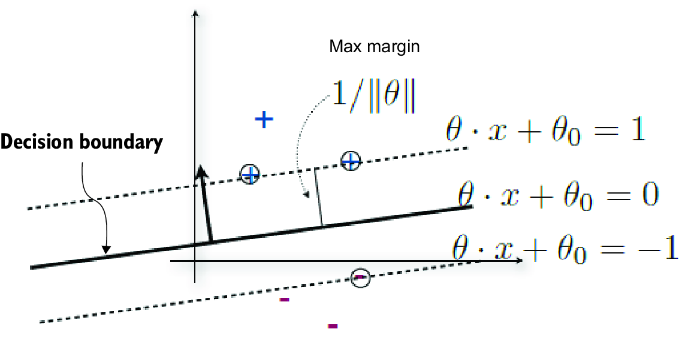
In a geometric maximum-margin solution, the points touching the two margin boundaries are the support vectors; changing these boundary-touching points can change the learned classifier. section 5.3

Figure 5.8 Max margin solution of SVM classifier
figure

Use the maximum-margin diagram to inspect how support vectors sit on the margin boundaries and constrain the classifier. section 5.3

How Machine Learning Algorithms in Depth covers it

How deep it goes
Derives support vectors from margin-constrained optimization and connects them to dual inner products, but does not detail their numerical selection.
Examples
Uses a maximum-margin geometry figure to show training points lying on the two margin boundaries.
What it assumes
Assumes familiarity with classification, vectors, optimization constraints, l2 norms, inner products, and Lagrange multipliers.
What you can do after
Evaluate which training points determine an SVM solution and why the dual formulation can focus on their interactions.
How it connects
Connects support vectors to support vector machines, maximum-margin classification, constrained optimization, duality, inner products, and kernel functions.

Related concepts

This explainer was generated by Manning's knowledge graph from the text of Machine Learning Algorithms in Depth. The section links point to the parts of the book it draws on.