A supporting subdomain helps a business deliver its core capabilities without being a major source of differentiation on its own. It sits between a core domain, where distinctive capabilities justify substantial investment, and a generic subdomain, where an off-the-shelf solution may suffice. Supporting subdomains usually contain company- or industry-specific logic, so they are typically built in-house. section 10.2 section 10.5
A capability that unlocks another
For a shared-scooter company, better placement planning could become a lasting source of differentiation. But more dynamic placement also depends on scooter placement logistics: software and technicians must move scooters where they are needed. Investing in this supporting subdomain enables the core opportunity, even though moving scooters is not itself the distinctive offer. section 10.2.1
Supporting does not mean simple, inexpensive, or safe to neglect. Scooter journeys, for example, is a supporting subdomain that must operate reliably at scale: downtime prevents riders from taking journeys. Model complexity and operational demands are worth discussing separately when deciding how to invest. section 10.2.1 section 10.5
Use a Core Domain Chart to make the investment decision collaboratively:
- Bring business, product, domain, and technical perspectives together to place subdomains by differentiation and model complexity. section 10.2
- Discuss each subdomain’s challenges and opportunities; use arrows to show a possible investment or change over time. section 10.2.4 section 10.5
- Ask whether improving a supporting subdomain would unlock a core capability, remove costly work, or make its software easier to evolve. section 10.2.1 section 10.2.4
Choosing the first modernization step
At an events scale-up, two core domains initially looked like the strongest investments. The group instead chose a supporting subdomain first. Improving it would remove a slow manual process, reduce operational costs, and give a team a chance to model a domain whose code had been scattered across codebases. The choice addressed a business bottleneck while preparing the organization for further change. section 10.2.4
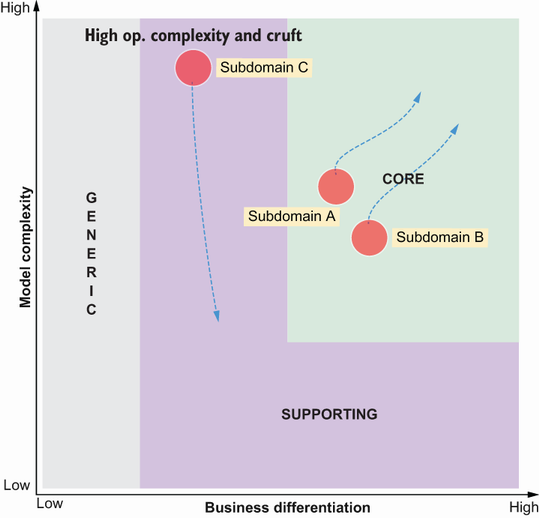
The shortlisted-subdomains chart contrasts investment in two core domains with an arrow toward lower complexity for the chosen supporting subdomain. section 10.2.4
