A switch strategy abandons the initially selected door for the other unopened door. In the three-door game, switching wins two times out of three, while staying wins one time out of three. section 6.3.1
The apparent 50–50 split is incorrect because the host knows the prize location and deliberately opens a goat door that is neither the initial choice nor the car door. The host’s constrained action preserves the original one-third probability and concentrates the remaining two-thirds on the other unopened door. section 6.3.1
A causal model makes the strategy operational:
- Represent the car location and first choice as exogenous variables, then model the host’s door selection from those causes. section 6.3.3
- Represent the second choice as a function of the strategy, host selection, and first choice. section 9.2.2
- Connect the second choice and car location to the win-or-lose outcome through deterministic conditional probability tables. section 9.2.2 section 6.3.3
Counterfactual switching
Conditioning on a player who stayed and lost, then intervening to set the hypothetical strategy to switch, gives a 100% chance of winning. Conditioning only on having lost gives a two-thirds chance of winning under the hypothetical switch. section 9.2.4
Figure 6.19 The Monty Hall problem. Each door has an equal probability of concealing a prize. The player chooses a door initially, the host reveals a losing door, and the player has the option to switch their initial choice. Contrary to intuition, the player should switch; if they switch, they will win two out of three times. This illustration assumes door 1 is chosen, but the results are the same regardless of the initial choice of door.
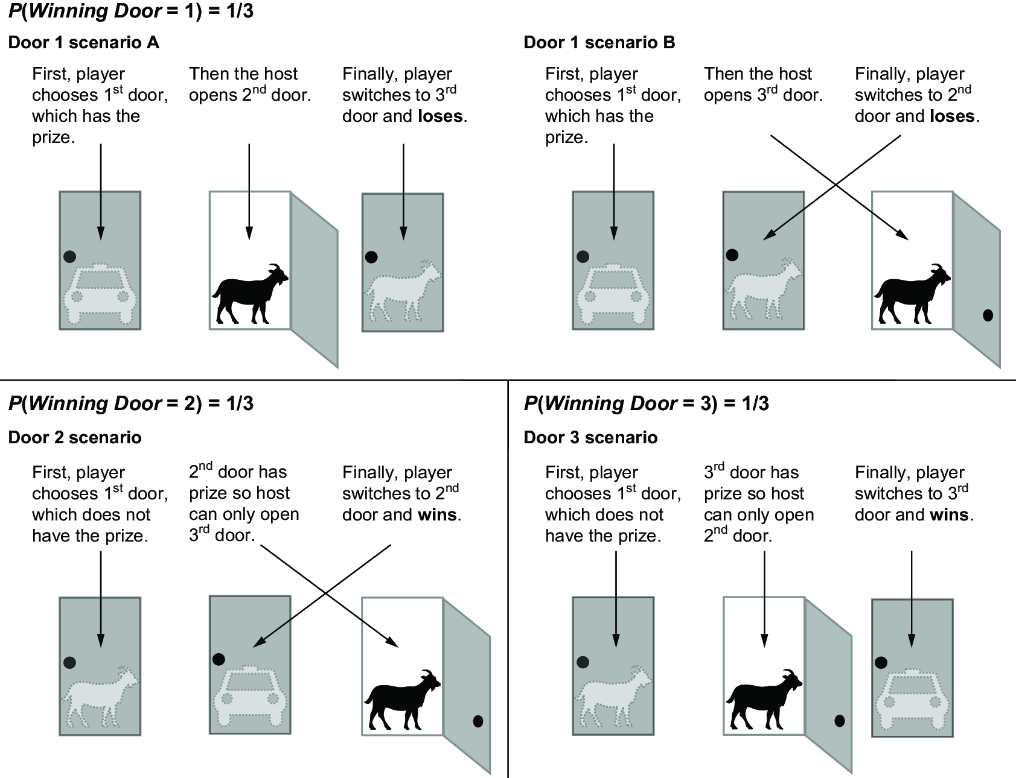
The door diagram makes the one-third versus two-thirds asymmetry visible after the host reveals a losing door. section 6.3.1
