A switching cost is the effort, expense, or disruption a customer incurs when replacing one product or provider. It acts as a competitive moat: leaving costs too much, even when a rival has a better offer. section 5.4
Assess switching costs alongside other forms of competitive defense:
- Network effects increase value as more users join. section 5.4
- Brand creates implicit trust in the company name. section 5.4
- Counter-positioning makes imitation threaten the rival's existing business model. section 5.4
Cal.com and Calendly
Cal.com combines switching costs with counter-positioning. Its developer features, platform API, embedding system, white-label branding, and OAuth layer create a deeper product base, while removing Calendly branding attacks a commitment Calendly relies on for marketing. section 5.4
Figure 5.7 The four competitive moats, or reasons a rival can't catch up: switching costs (leaving costs too much), network effects (each new user adds value), brand (a trusted name), and counter-positioning (copying you would break the rival, just as matching a "free" price would drain an incumbent's revenue). Cal.com combines counter-positioning with switching costs, and the moats a product holds predict where it invests next.
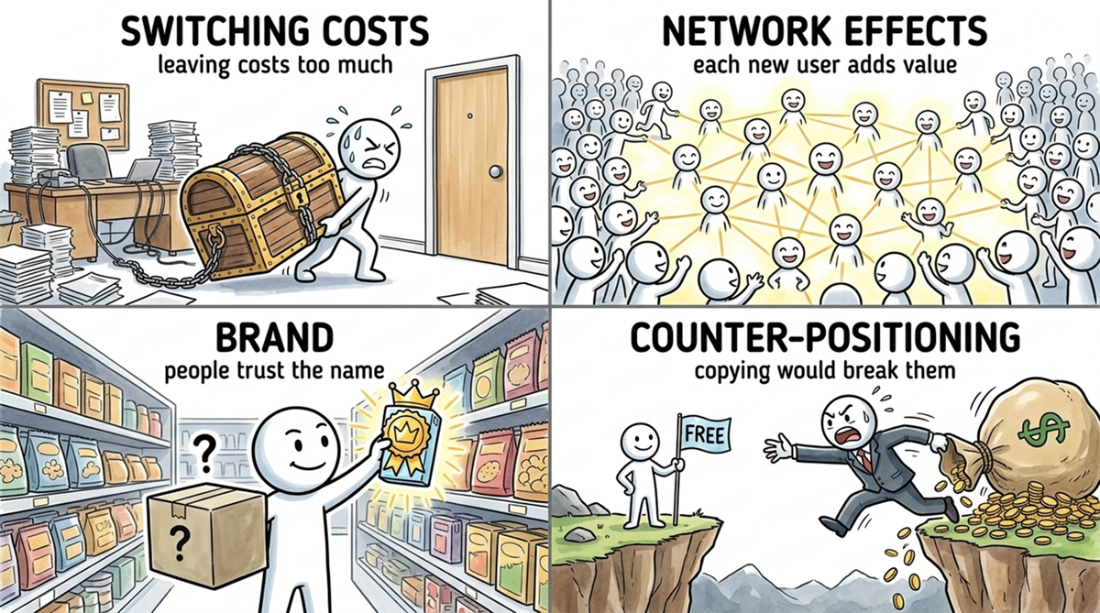
Use the four-moat diagram to compare switching costs with network effects, brand, and counter-positioning, then identify where a product should invest. section 5.4
